Managing oily skin can be challenging, especially in a hot and humid climate such as Nigeria. Excess sebum can leave the face looking shiny and greasy while contributing to clogged pores, blackheads, whiteheads and acne breakouts. Choosing the right cleansing and skincare products can therefore make a significant difference.
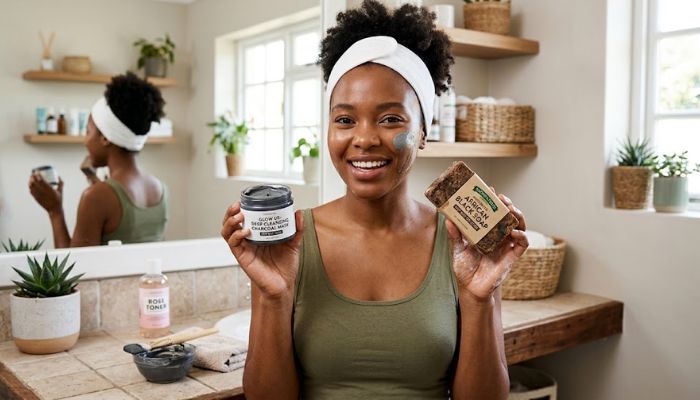
Two popular options often considered by people with oily skin are charcoal masks and African black soap. Both are known for deep-cleansing properties, but they work differently and are not necessarily suitable for everyone.
A charcoal mask is generally designed as a targeted treatment that helps absorb excess oil and impurities from the skin. African black soap, on the other hand, is traditionally used as a cleansing soap and is often made with ingredients such as plantain ash, cocoa pod ash, palm oil, coconut oil or shea butter, depending on the formulation.
The answer depends on your skin’s needs, how frequently you use the product and the specific formulation. In this guide, we will compare both options, explain their benefits and potential drawbacks, and show you how to incorporate them into an oily-skin routine.
What Is a Charcoal Mask?
A charcoal mask is a facial treatment containing activated charcoal, an ingredient known for its highly porous structure. It is commonly marketed as a deep-cleansing treatment because charcoal can adsorb substances from the skin’s surface.
Charcoal masks are particularly popular among people with oily or combination skin because they can help remove excess oil, dirt and other impurities.
Depending on the formulation, a charcoal mask may also contain ingredients such as clay, salicylic acid, aloe vera, niacinamide or botanical extracts.
Benefits of Charcoal Masks for Oily Skin
1. Helps absorb excess oil
One of the main reasons charcoal masks are popular for oily skin is their ability to absorb excess surface oil. This can temporarily reduce shine and leave the skin feeling cleaner.
2. Helps remove impurities
A properly formulated mask can help lift dirt, oil and buildup from the skin’s surface, particularly when used after cleansing.
3. Can make pores appear less noticeable
Pores cannot permanently be closed or eliminated, but removing excess oil and buildup can make them appear temporarily less noticeable.
4. Provides occasional deep cleansing
Unlike a daily cleanser, a charcoal mask is generally used as an occasional treatment. This makes it useful when your skin feels particularly oily or congested.
5. Can complement an oily-skin routine
When combined with a gentle cleanser, lightweight moisturizer and sunscreen, a charcoal mask can be part of a balanced skincare routine.
What Is African Black Soap?
African black soap is a traditional cleansing product associated with West African skincare practices. It is often made using plant-derived ingredients, although formulations vary considerably between manufacturers.
Traditional versions may contain ash derived from plantain skins, cocoa pods or other plant materials combined with oils or butters.
African black soap is widely used for cleansing the face and body and is especially popular among people looking for a simple, traditional cleansing option.
Benefits of African Black Soap for Oily Skin
1. Cleanses excess oil
Black soap can remove oil, sweat and dirt from the skin, which may make it appealing to people with oily skin.
2. Provides a thorough cleansing experience
Some formulations produce a rich lather that helps remove daily buildup from the skin.
3. Can be used on the face and body
Depending on the formulation and the manufacturer’s instructions, African black soap may be used as a multipurpose cleanser.
4. Contains plant-derived ingredients
Traditional formulations can contain plant-based ingredients and natural oils. However, “natural” does not automatically mean that a product will be gentle or suitable for every skin type.
5. Can fit into a simple skincare routine
For people who prefer minimalist skincare, a suitable black soap formulation can serve as a cleanser rather than requiring several different cleansing products.
Charcoal Mask vs African Black Soap: Key Differences
Although both products can help with oily skin, they serve different purposes.
Feature
Charcoal Mask
African Black Soap
Primary purpose
Occasional treatment
Cleansing
Main benefit
Helps absorb excess oil and impurities
Removes dirt, sweat and oil
Typical use
Once or occasionally per week
Depending on formulation, potentially more regularly
Application
Applied and left on temporarily
Used as a cleanser and rinsed off
Best suited for
Oily or congested skin needing occasional treatment
People seeking a cleansing product
Potential concern
Can be drying if overused
Can be drying or irritating in some formulations
The biggest difference is simple: African black soap is primarily a cleanser, while a charcoal mask is primarily a treatment.
Which Is Better for Oily Skin?
There is no universal winner because your skin may respond differently to each product.
If your main concern is daily cleansing and removing excess oil, a well-formulated African black soap may be more practical.
If your main concern is occasional excess oil, congestion and buildup, a charcoal mask may be more useful.
For many people, the best approach may actually be using neither product excessively. Oily skin still needs hydration, and aggressively stripping away oil can potentially leave the skin irritated and uncomfortable.
When to Choose a Charcoal Mask
A charcoal mask may be a better option if:
Your face becomes excessively oily.
You experience occasional clogged pores.
Your skin feels congested.
You want an occasional deep-cleansing treatment.
You prefer a product specifically designed for periodic facial use.
However, avoid assuming that a stronger or more drying mask will produce better results.
When to Choose African Black Soap
African black soap may be preferable if:
You want a cleansing product rather than a treatment mask.
You prefer traditional skincare ingredients.
You want a simple cleanser for removing sweat and oil.
Your particular black soap formulation does not irritate your skin.
Always check the formulation because commercially available African black soaps can differ significantly in ingredients, fragrance, texture and pH.
Can You Use Charcoal Mask and African Black Soap Together?
Yes, but you need to be careful.
Using both products in the same routine can potentially be too drying, particularly if the black soap is harsh or the charcoal mask contains additional exfoliating ingredients.
If you want to use both, consider using the black soap as your cleanser and the charcoal mask as an occasional treatment rather than applying them aggressively one after another.
If your skin becomes tight, flaky, itchy, red or uncomfortable, reduce usage or discontinue the product causing the irritation.
Is African Black Soap Good for Acne-Prone Oily Skin?
African black soap may help remove excess oil and surface impurities, but it should not be considered an acne treatment by itself.
Acne can involve excess sebum, clogged pores, inflammation and other factors. A cleanser can help keep the skin clean, but cleansing alone may not address persistent acne.
People with acne-prone skin should also be cautious about highly fragranced or very drying black soap formulations. A product that leaves your skin extremely tight after washing may not be the best choice for regular facial use.
If acne is persistent, painful or severe, professional dermatological advice is more appropriate than repeatedly changing cleansers.
Is Charcoal Mask Good for Oily Skin?
Charcoal masks can be useful for oily skin because they are designed to absorb excess surface oil and remove impurities.
However, results are usually temporary. A charcoal mask will not permanently stop your sebaceous glands from producing oil.
For best results, use the mask according to its instructions rather than leaving it on longer than recommended. Using it too frequently may cause dryness or irritation.
Also, be cautious with peel-off charcoal masks. Some can be uncomfortable to remove and may irritate sensitive skin.
Which One Is Better for Nigerian Skin?
For Nigerian consumers, climate is an important consideration. Hot and humid conditions can increase sweating and make oily skin feel even greasier.
However, this does not mean Nigerian skin needs aggressive cleansing.
A better strategy is to select products according to your individual skin type and concerns. Someone with very oily skin may enjoy an occasional charcoal mask, while another person may prefer a gentle cleanser.
If you choose African black soap, look for a formulation designed or clearly labelled for facial use and pay attention to how your skin responds.
Likewise, when selecting a charcoal mask, look beyond the word “charcoal.” Check the complete ingredient list and consider whether it contains additional ingredients that could potentially irritate your skin.
Common Mistakes to Avoid
1. Using charcoal masks too frequently
A charcoal mask is not necessarily better when used every day. Overuse can contribute to dryness and irritation.
2. Scrubbing oily skin aggressively
Oily skin still requires gentle care. Excessive scrubbing can damage the skin barrier and make your routine unnecessarily irritating.
3. Skipping moisturizer
Having oily skin does not mean you should avoid moisturizer. Choose a lightweight, non-comedogenic moisturizer if heavy creams feel uncomfortable.
4. Forgetting sunscreen
A good oily-skin routine should include sunscreen during the day. Choose a lightweight sunscreen that feels comfortable on your skin.
5. Assuming natural means irritation-free
African black soap is often associated with natural ingredients, but natural ingredients can still cause irritation. Your skin’s response matters more than marketing claims.
How to Build an Oily-Skin Routine
A simple routine is often better than using numerous harsh products.
Step 1: Cleanse
Use a suitable facial cleanser to remove sweat, oil and daily impurities.
Step 2: Treat specific concerns
If necessary, incorporate products containing proven skincare ingredients that target your specific concern, such as salicylic acid or niacinamide.
Step 3: Moisturize
Use a lightweight moisturizer to support the skin barrier.
Step 4: Apply sunscreen
During the day, finish with broad-spectrum sunscreen.
Step 5: Use a charcoal mask occasionally
If your skin tolerates it, incorporate a charcoal mask periodically when you want additional oil-control cleansing.
Final Verdict: Charcoal Mask vs African Black Soap
So, charcoal mask vs African black soap for oily skin: which is better?
Neither product is automatically better for everyone.
African black soap is primarily a cleanser, making it more appropriate when your goal is to remove sweat, dirt and excess oil as part of your cleansing routine.
A charcoal mask is primarily an occasional treatment, making it more suitable when you want additional oil absorption and a deeper cleansing experience.
For oily skin, the most important factor is not choosing the strongest product. It is maintaining a consistent routine that cleanses without excessively stripping the skin.
If you enjoy African black soap and your skin tolerates it well, it can be incorporated into your routine. If your skin benefits from occasional oil-control treatments, a charcoal mask may be useful.
Ultimately, the best choice is the product that effectively meets your skin’s needs without causing dryness, irritation or damage to your skin barrier.
For shoppers in Nigeria, always check the product ingredients, follow the manufacturer’s directions and patch-test new skincare products when appropriate.













 Get it on
  Download on the