






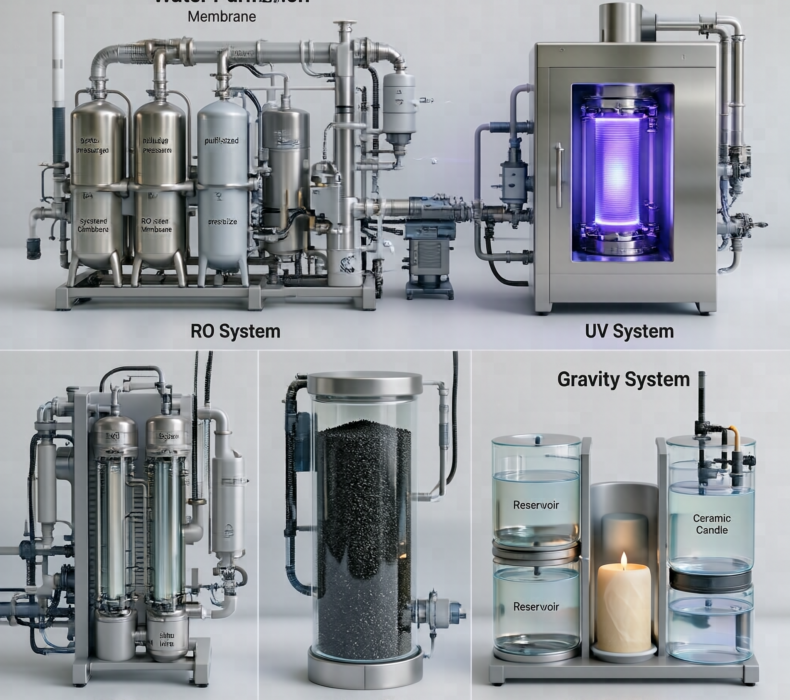
Clean drinking water is essential for every household, yet water from different sources can contain different impurities. Understanding the Types of Water Purifiers and How They Work can help you choose a suitable system for your home, office, or business. Whether you depend on borehole water, well water, tap water, or another source, the right purifier can improve water quality by targeting specific contaminants.
Although many water purifiers look similar from the outside, their internal technologies can be very different. Some systems use membranes, while others rely on activated carbon, ultraviolet light, gravity, or combinations of several technologies. Therefore, knowing how each type works is important before spending money on a new water purifier.
Why Do You Need a Water Purifier?
Water can become contaminated at different points between its source and the point where it is consumed.
For example, water may contain:
- Sand and sediment
- Rust particles
- Excess minerals
- Unpleasant tastes and odours
- Microorganisms
- Certain chemicals
- Dissolved solids
Furthermore, water stored in tanks or containers can be affected by poor maintenance and handling.
A water purifier is designed to treat water using one or more purification methods. However, no single purifier removes every possible contaminant. Therefore, choosing the right technology starts with understanding the quality of your water.
Types of Water Purifiers and How They Work
The Types of Water Purifiers and How They Work vary according to the purification technology used.
The most common types include:
- Reverse Osmosis (RO) purifiers
- Ultraviolet (UV) purifiers
- Ultrafiltration (UF) purifiers
- Activated carbon purifiers
- Gravity-based purifiers
- Sediment filtration systems
- Multi-stage water purifiers
Each system has different strengths. Consequently, the best option depends on the water source and the impurities that need to be treated.
1. Reverse Osmosis Water Purifiers
Reverse osmosis, commonly known as RO, is one of the most advanced household water purification methods.
RO systems use pressure to push water through a semi-permeable membrane. The membrane allows water molecules to pass while reducing many dissolved substances.
How RO Purifiers Work
Water normally passes through several stages before reaching the storage tank.
A typical RO system may contain:
- Sediment filter
- Activated carbon filter
- RO membrane
- Post-carbon filter
- Additional treatment stages
First, the sediment filter removes larger particles. Next, the carbon filter helps reduce certain chemicals, tastes, and odours.
Afterward, water passes through the RO membrane, which reduces many dissolved substances. Finally, the water may pass through another filter before consumption.
Benefits of RO Purifiers
RO systems can be useful for water with:
- High TDS
- Excess dissolved minerals
- Certain unwanted chemical substances
- Some heavy metals
However, RO systems can produce wastewater and require regular filter and membrane replacement.
Therefore, they are most useful when their capabilities match the quality of the water being treated.
2. Ultraviolet Water Purifiers
UV purification uses ultraviolet light to treat microorganisms in water.
Instead of physically filtering contaminants, the UV light disrupts microorganisms so they cannot reproduce normally.
How UV Purifiers Work
Water flows through a chamber containing a UV lamp.
As the water passes through the chamber, the ultraviolet light treats microorganisms present in the water.
Therefore, UV technology can be useful when microbial contamination is a major concern.
Advantages of UV Purification
UV systems can:
- Treat many microorganisms
- Work quickly
- Avoid adding chemicals to the water
- Complement other filtration technologies
However, UV treatment does not remove dissolved salts, sediment, or many chemical contaminants.
Consequently, it is often combined with pre-filtration.
3. Ultrafiltration Water Purifiers
Ultrafiltration, or UF, uses a membrane with very small pores to filter water.
The pores are smaller than those used in many conventional filters. However, UF membranes generally do not remove dissolved salts and many other dissolved substances as effectively as RO.
How UF Purifiers Work
Water passes through a membrane that traps many suspended particles and microorganisms.
Because UF systems can operate without high-pressure pumps, some models can work without electricity.
Therefore, UF can be useful for households looking for simple membrane filtration.
Benefits of UF Purifiers
UF systems can offer:
- Fine filtration
- Low energy requirements
- No need for high-pressure pumps
- Useful sediment and microorganism reduction
However, UF is not a substitute for RO when the main concern is high dissolved-solids content.
4. Activated Carbon Water Purifiers
Activated carbon is widely used in water filtration systems.
Carbon has a highly porous structure that can adsorb certain substances as water passes through it.
How Carbon Filters Work
Water flows through activated carbon media.
During this process, the carbon can help reduce certain organic compounds, chlorine-related tastes, and unpleasant odours.
As a result, filtered water may taste and smell better.
Benefits of Carbon Filtration
Activated carbon filters are useful for:
- Taste improvement
- Odour reduction
- Chlorine reduction
- Certain organic contaminants
However, carbon filtration alone does not address every water quality problem.
Therefore, it is often used as one stage within a multi-stage purification system.
5. Gravity Water Purifiers
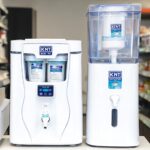
Gravity-based purifiers use gravity rather than an electric pump to move water through filtration media.
They are among the simplest types of water purification systems.
How Gravity Purifiers Work
Untreated water is placed in an upper chamber.
Gravity causes the water to move through a filter into a lower storage chamber.
Depending on the model, the filter may use ceramic, UF membrane, activated carbon, or other filtration media.
Advantages of Gravity Purifiers
Gravity purifiers can be useful because they:
- Do not necessarily require electricity
- Are relatively simple to operate
- Can be convenient during power interruptions
- Are suitable for certain household applications
Nevertheless, their performance depends heavily on the filter technology used.
6. Sediment Water Filters
Sediment filters focus primarily on physical particles.
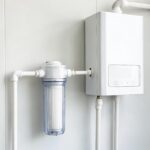
They are often used as the first stage of a larger purification system.
How Sediment Filters Work
Water passes through a filter material designed to trap suspended particles.
These may include:
- Sand
- Dirt
- Silt
- Rust
- Other visible particles
Consequently, sediment filtration helps protect more sensitive filters further down the purification system.
However, sediment filters do not generally remove dissolved minerals or microorganisms by themselves.
7. Multi-Stage Water Purifiers
Multi-stage systems combine two or more purification technologies.
For example, a purifier may use:
Sediment filter → Carbon filter → RO membrane → UV treatment → Post-filter
Each stage performs a different function.
First, sediment filtration removes larger particles. Next, carbon filtration improves taste and reduces certain substances.
Afterward, RO filtration addresses many dissolved contaminants. Finally, UV treatment can provide additional microbial treatment.
Therefore, multi-stage systems can offer broader treatment than a single filtration technology.
RO vs UV vs UF: Which One Is Better?
There is no universal winner.
The right choice depends on the water quality.
| Technology | Best Suited For | Electricity |
|---|---|---|
| RO | High TDS and many dissolved substances | Usually required |
| UV | Microorganisms | Required |
| UF | Suspended particles and some microorganisms | Not always required |
| Carbon | Taste, odour, and selected chemicals | Not necessarily |
| Gravity | Basic filtration without electricity | Usually not required |
For example, a household with high-TDS borehole water may benefit from RO.
On the other hand, a home with relatively low-TDS water but microbial concerns may consider UV-based treatment.
Therefore, water testing should come before choosing a technology.
Which Water Purifier Is Best for Well Water?
Well water may also require treatment before drinking.
Because wells can be exposed to environmental contamination, microbial testing is particularly important.
A suitable system may combine:
- Sediment filtration
- Activated carbon
- UV treatment
- RO where necessary
However, the exact configuration should be based on test results.
Which Water Purifier Is Best for Tap Water?
Tap water quality varies depending on the source and distribution system.
If the water is already treated but has an unpleasant taste or odour, an activated carbon filter may be sufficient.
However, if testing reveals other contaminants, a more advanced system may be necessary.
Therefore, avoid purchasing an expensive purifier simply because it has more filtration stages.
Water Purifier Maintenance Tips
Regular maintenance helps keep a purification system working effectively.
Replace Filters
Filters gradually collect contaminants.
Therefore, replace them according to the manufacturer’s recommendations.
Clean Storage Tanks
If your purifier has a storage tank, clean it regularly.
This helps reduce the risk of contamination after purification.
Inspect Pipes and Connections
Check the system for leaks or damaged connections.
If you notice a problem, have it inspected by a qualified technician.
Monitor Water Taste and Appearance
Changes in taste, odour, or appearance can indicate that maintenance is required.
Consequently, unusual changes should not be ignored.
Common Mistakes When Buying a Water Purifier
Choosing Based Only on Price
The cheapest purifier is not necessarily the best option.
A low-cost system may have expensive replacement filters or may not address your water quality problem.
Assuming All Purifiers Work the Same Way
RO, UV, UF, carbon, and gravity systems work differently.
Therefore, understand the technology before buying.
Ignoring Water Testing
Clear-looking water is not necessarily free from contaminants.
Testing provides useful information that cannot be obtained simply by looking at the water.
Forgetting Maintenance Costs
A purifier is a long-term appliance.
Consequently, consider the cost and availability of replacement filters before purchasing.
Benefits of Understanding Water Purification Technologies
Learning about the Types of Water Purifiers and How They Work can make shopping easier.
You will be able to:
- Compare different purification technologies
- Identify suitable systems for your water source
- Understand maintenance requirements
- Avoid unnecessary features
- Estimate long-term costs
- Make a more informed buying decision
Furthermore, understanding purification technology can help you recognise misleading product claims.
Conclusion
Understanding the Types of Water Purifiers and How They Work is the first step toward choosing an effective water treatment system. RO, UV, UF, activated carbon, gravity, sediment, and multi-stage systems all serve different purposes.
For Nigerian households, the most suitable purifier depends on the quality of the water source. Therefore, test your water before making a purchase, compare purification technologies, and consider long-term maintenance costs.
Ultimately, the best water purifier is not necessarily the most expensive model. Instead, it is the system that effectively addresses the specific water quality concerns in your home while remaining practical to maintain.



 Get it on
  Download on the