






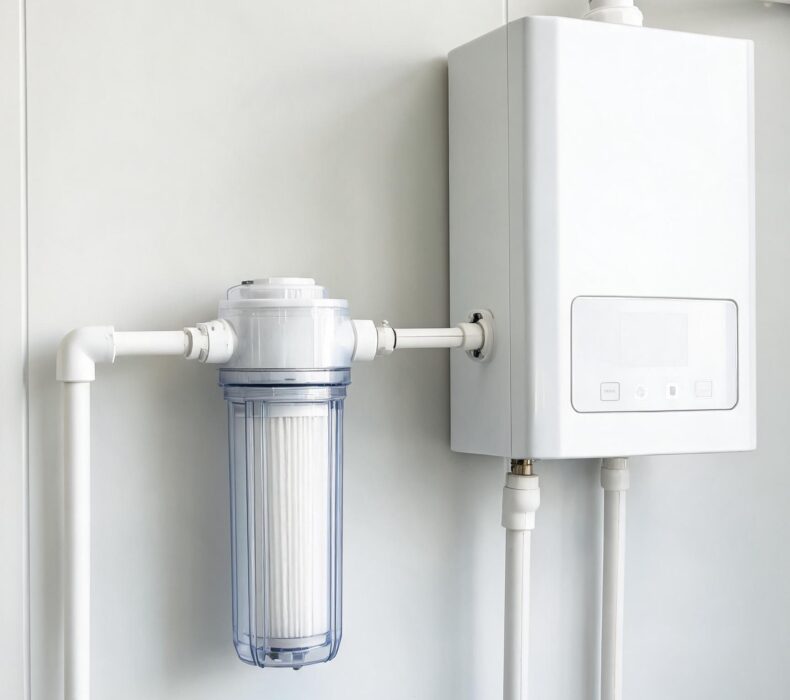
Hot water is useful for bathing, washing, cleaning, and other household activities. However, the quality of the water entering your heater can affect both your comfort and the condition of the appliance. A water purifier for water heater can help address certain water-quality problems before or around the heating system. Therefore, understanding how filtration works with a water heater can help homeowners make better decisions about their plumbing setup.
Many people assume that a water heater itself improves water quality because it heats the water. However, heating water and purifying water are two different processes. A heater primarily raises water temperature, while a purifier is designed to reduce specific impurities. Consequently, combining the right filtration system with a water heater can be useful when your water source has sediment, hardness, unpleasant odours, or other concerns.
What Is a Water Purifier for Water Heater?
A water purifier for water heater is a filtration or water-treatment system used to improve the quality of water before it reaches the heater or at a suitable point within the plumbing system.
The purifier does not replace the water heater. Instead, the two appliances perform different jobs.
A purifier may reduce:
- Sediment
- Sand
- Rust particles
- Certain chemicals
- Unpleasant tastes and odours
- Some microorganisms
- Certain dissolved substances, depending on technology
Meanwhile, the water heater raises the temperature of the water.
Therefore, using both systems can address water quality and hot-water requirements separately.
Why Use a Water Purifier Before a Water Heater?
Water heaters can be exposed to the same water-quality problems found throughout a home’s plumbing system.
For example, sediment and mineral deposits can accumulate inside plumbing components and, depending on the heater design and water chemistry, contribute to scaling or other maintenance issues.
A suitable filtration system can help reduce some of these problems.
Reduces Sediment
If your water contains sand, dirt, rust, or other suspended particles, a sediment filter can trap these materials before the water reaches the heater.
As a result, less particulate matter travels through the plumbing system.
Helps Manage Certain Water Quality Problems
Different purifier technologies target different contaminants.
For example, activated carbon can improve taste and odour, while RO can reduce many dissolved substances.
However, the correct technology depends on your water quality.
Can Support Appliance Maintenance
Cleaner incoming water can reduce the amount of sediment entering plumbing equipment.
Therefore, filtration may contribute to easier maintenance, although it cannot prevent every type of water-heater problem.
Does a Water Heater Purify Water?
No.
A standard water heater is designed primarily to heat and store or deliver hot water.
Although heating can affect microorganisms under certain conditions, a water heater should not be treated as a certified drinking-water purification system.
It does not automatically remove:
- Sand
- Rust
- Dissolved salts
- Hardness
- Heavy metals
- Many chemicals
Therefore, if you need treated drinking water, use an appropriate water purification system rather than relying on your heater.
Types of Water Purifiers That Can Work With Water Heaters
Not every purifier is suitable for every plumbing application.
The best option depends on the water source, the heater, and the intended use.
Sediment Filters
Sediment filters are among the simplest options.
They are designed to trap suspended particles such as sand, silt, dirt, and rust.
Therefore, they can be useful as a pre-filter where particulate contamination is a concern.
They are particularly relevant for homes using borehole or well water that contains visible sediment.
Activated Carbon Filters
Activated carbon filters can help reduce certain substances that affect taste and odour.
They are commonly used as part of multi-stage water filtration systems.
However, carbon filters do not remove every contaminant.
Therefore, they should be selected according to the actual water quality rather than simply being installed because they are popular.
Reverse Osmosis Systems
Reverse osmosis, commonly called RO, uses a semi-permeable membrane to reduce many dissolved substances.
RO can be useful where water has high total dissolved solids or other contaminants that RO is designed to reduce.
However, RO is generally more appropriate for drinking-water treatment than for supplying an entire household’s hot-water system.
For this reason, homeowners should carefully consider where the RO system is installed.
UV Water Purifiers
UV systems use ultraviolet light to treat microorganisms.
They can be useful when microbiological contamination is a concern.
However, UV does not remove sediment, hardness, or dissolved minerals.
Consequently, UV systems often work alongside other filtration technologies.
Whole-House Water Filtration Systems
For homeowners who want to improve water quality throughout the property, a whole-house filtration system may be more suitable.
Such systems are installed at a point where they can treat water entering multiple outlets.
Therefore, filtered water can reach showers, sinks, washing machines, and water heaters.
The exact system should depend on the results of water testing.
Benefits of Using a Water Purifier With a Water Heater
Better Water Quality
A suitable filtration system can reduce specific impurities.
Consequently, water may have a cleaner appearance, taste, or odour, depending on the filter technology.
Protection From Sediment
Pre-filtration can reduce the amount of suspended material entering the heater.
This can be especially useful when the incoming water contains visible particles.
Potentially Less Scaling
Certain water-treatment systems can reduce substances associated with scale formation.
However, ordinary sediment filtration does not remove hardness.
Therefore, homes with hard water may require a dedicated water-softening or other appropriate treatment solution.
Cleaner Shower Water
Whole-house filtration can improve the quality of water used for bathing.
For example, reducing sediment can help prevent particles from appearing in shower water.
Convenient Household Water Management
A properly designed system can treat water before it reaches multiple household outlets.
As a result, homeowners may not need separate basic filters at every outlet.
Water Purifier for Water Heater in Nigerian Homes
Water sources in Nigeria vary considerably.
Many households depend on boreholes, wells, water tankers, or treated public water.
As a result, water quality can differ significantly between homes and locations.
Borehole water, for instance, may contain sediment, iron, hardness, or high dissolved-solids levels.
Consequently, Nigerian homeowners should test their water before choosing a filtration system.
A purifier that works well for one home may not be suitable for another.
Hard Water and Water Heaters
Hard water contains elevated levels of minerals such as calcium and magnesium.
When heated, hard water can contribute to mineral scale formation.
Over time, scale can affect plumbing components and certain types of heating equipment.
However, a standard sediment or carbon filter does not necessarily remove water hardness.
Therefore, households with confirmed hard water may need a water softener or another treatment technology designed specifically for hardness.
Borehole Water and Water Heaters
Borehole water is common in many Nigerian homes.
However, borehole water quality is not uniform.
Some sources may contain:
- Iron
- Sand
- Sediment
- Hardness
- High TDS
- Microorganisms
A water test can help determine which treatment stages are appropriate.
For example, sediment filtration may be useful when sand is present, while additional treatment may be required for dissolved minerals.
Therefore, avoid purchasing a purifier based solely on the fact that you use borehole water.
How to Choose the Right Water Purifier for Water Heater
Test the Water
Start with a water-quality test.
Testing can help identify the specific contaminants that need attention.
Identify the Purpose
Ask whether you want to filter:
- Drinking water
- Shower water
- Hot water
- The entire house
- Water entering the heater
The answer can influence the type and location of the purifier.
Consider Flow Rate
A whole-house filtration system must handle the required water flow.
Therefore, choose a system that can supply your household without creating unnecessary pressure problems.
Check Temperature Limits
Not every water filter is designed to handle hot water.
Consequently, filtration systems should generally be installed according to the manufacturer’s temperature and installation requirements.
Do not assume that a regular cold-water filter can safely be installed directly on a hot-water line.
Consider Maintenance
Filters require replacement or cleaning.
Therefore, check the availability and cost of replacement cartridges before buying.
How to Maintain a Water Purifier Connected to a Water Heater
Regular maintenance is essential.
Replace Filters on Time
A clogged filter can restrict water flow and reduce filtration performance.
Therefore, follow the recommended replacement schedule.
Inspect for Leaks
Check pipes and connections regularly.
If you notice leaking water, have the system inspected promptly.
Clean Storage Components
If the purification system has a storage tank, clean it according to the manufacturer’s recommendations.
Maintain the Water Heater
Filtration does not eliminate the need for water-heater maintenance.
Depending on the heater type, maintenance may include checking connections, valves, heating elements, and other components.
Therefore, follow the manufacturer’s service instructions.
Conclusion
A water purifier for water heater can be a useful addition to a household water system, particularly when the incoming water contains sediment, unpleasant odours, hardness, or other contaminants. However, purification and water heating perform different functions.
A water heater heats water, while a purifier treats water according to its specific technology. Therefore, installing the right filtration system before the heater can help improve incoming water quality and potentially reduce certain maintenance concerns.
Most importantly, make sure the filtration equipment is designed for its intended location and temperature. With proper installation, regular filter replacement, and routine water-heater maintenance, you can create a more reliable and efficient household water system.


 Get it on
  Download on the