






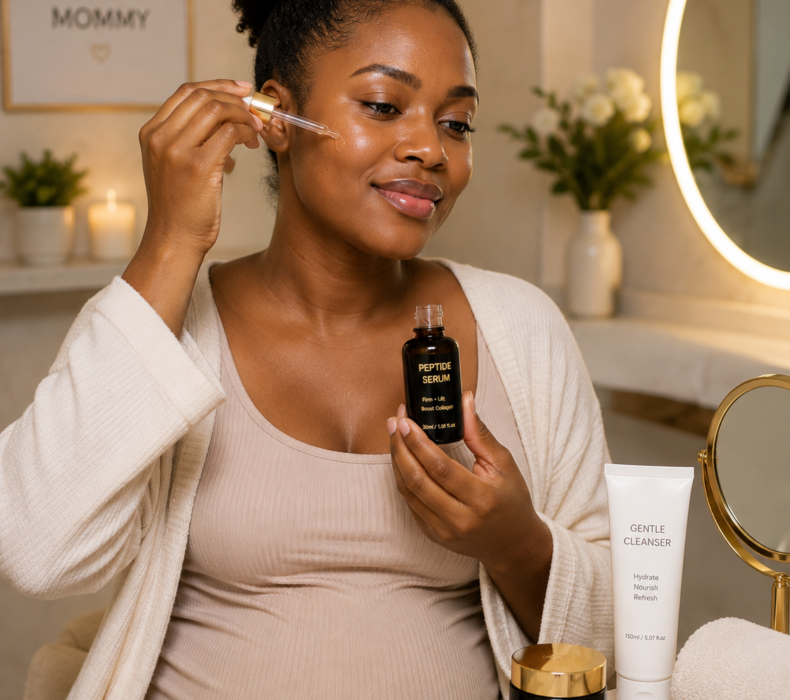
Pregnancy is an exciting period, but it can also bring significant changes to your skin. Hormonal fluctuations may cause dryness, sensitivity, acne, uneven skin tone, hyperpigmentation, or the appearance of fine lines. As a result, many expectant mothers look for gentle skincare products that can keep their skin hydrated, healthy, and radiant.
One ingredient that has become increasingly popular in modern skincare is peptides. Peptide serums are marketed for supporting smoother, firmer, hydrated, and youthful-looking skin. But if you are pregnant or trying to conceive, you may wonder: Is peptide serum during pregnancy safe?
The short answer is that topical peptide skincare is generally considered a lower-concern ingredient, but pregnancy-specific safety data for individual peptide formulations are limited. Because products can contain multiple ingredients, pregnant women should check the entire product label rather than assuming a serum is safe simply because it contains peptides. When in doubt, consult your obstetrician or dermatologist.
What Are Peptides in Skincare?
Peptides are short chains of amino acids that are used in skincare formulations for their potential effects on the appearance and condition of the skin.
Certain peptides can act as signaling molecules that support processes associated with skin proteins such as collagen and elastin. Depending on the type of peptide used, a serum may be formulated to improve the appearance of firmness, fine lines, texture, or hydration.
This is why peptide serum has become popular among people looking for anti-aging skincare without necessarily using stronger active ingredients.
However, not every peptide product is formulated the same way. A serum may contain peptides alongside ingredients such as hyaluronic acid, niacinamide, botanical extracts, fragrances, acids, or retinoids.
For pregnancy skincare, therefore, the complete ingredient list matters.
Is Peptide Serum During Pregnancy Safe?
There is no simple universal answer for every peptide serum because safety depends on the specific formulation and the ingredients included.
Topical peptides are generally viewed as a relatively gentle skincare category, and peptides are commonly used in serums and moisturizers. However, there is limited research specifically evaluating every cosmetic peptide ingredient during pregnancy.
The American Academy of Dermatology recommends that pregnant people pay close attention to skincare ingredients and discuss uncertain products with their obstetrician or dermatologist. It also recommends avoiding certain ingredients during pregnancy, particularly retinoids and hydroquinone.
Therefore, if you are considering peptide serum during pregnancy, look beyond the word “peptide” on the front of the bottle.
Check the Complete Ingredient List
A peptide serum may contain several active ingredients. Before applying it, check whether it also contains ingredients that your healthcare provider has advised you to avoid.
For example, some anti-aging products containing peptides may also contain retinol or other retinoids.
The American Academy of Dermatology recommends avoiding retinoids during pregnancy, including prescription retinoids and over-the-counter skincare containing retinol.
This is one reason why reading the ingredient label is particularly important.
Potential Benefits of Peptide Serum During Pregnancy
Pregnancy can change the way your skin behaves. Some women experience dryness and sensitivity, while others notice increased oiliness, acne, or pigmentation.
A simple peptide serum may offer several skincare benefits.
1. Helps Support Hydrated-Looking Skin
Some peptide formulations are combined with moisturizing ingredients such as hyaluronic acid and glycerin.
Keeping the skin adequately moisturized can help maintain a smoother and more comfortable skin barrier, particularly when pregnancy-related hormonal changes make the skin feel dry or sensitive.
2. Supports a Smoother-Looking Complexion
Peptide skincare is commonly used in anti-aging routines because certain peptides may support the appearance of firmer and smoother skin.
However, peptides should not be considered a miracle treatment. Research on cosmetic peptides is still developing, and the effectiveness can vary considerably between formulations.
3. Can Complement a Simple Skincare Routine
Pregnancy is often a good time to simplify your skincare routine.
Instead of using several strong active ingredients, you can focus on basic steps such as cleansing, moisturizing, and protecting your skin from the sun.
The American Academy of Dermatology recommends a simple pregnancy skincare routine that includes cleansing, moisturizing, and sun protection.
A peptide serum can potentially fit between cleansing and moisturizing if your healthcare professional agrees that the particular formulation is appropriate.
4. May Support the Appearance of Fine Lines
Peptide products are frequently marketed toward people concerned about visible fine lines and loss of firmness.
Rather than expecting dramatic anti-aging results, think of peptide serum as one component of a broader skincare routine focused on hydration, barrier support, and sun protection.
What Ingredients Should You Avoid During Pregnancy?
When choosing peptide serum during pregnancy, it is important to distinguish the peptide itself from other ingredients in the formula.
Retinoids and Retinol
Retinoids are among the most important skincare ingredients to avoid during pregnancy.
The American Academy of Dermatology recommends avoiding prescription retinoids as well as over-the-counter products containing retinol during pregnancy.
These include ingredients such as:
- Retinol
- Tretinoin
- Tazarotene
- Adapalene
- Isotretinoin
If your peptide serum contains retinol or another retinoid, do not assume that the product is pregnancy-friendly simply because it is labeled as a peptide serum.
Hydroquinone
Hydroquinone is another ingredient the American Academy of Dermatology recommends avoiding during pregnancy. It is commonly used in products designed to lighten hyperpigmentation.
Certain Prescription Treatments
Some prescription medications used for acne or other skin conditions are unsuitable during pregnancy. ACOG specifically notes that certain acne medications should not be used during pregnancy.
If you are using a prescription skincare product, speak with your doctor before continuing it during pregnancy.
What About Other Popular Skincare Ingredients?
Not every active skincare ingredient is automatically unsafe during pregnancy.
For example, ACOG states that certain over-the-counter ingredients, including topical azelaic acid, benzoyl peroxide, salicylic acid, and glycolic acid, can be used during pregnancy under appropriate circumstances.
However, the American Academy of Dermatology advises discussing certain ingredients with your dermatologist and limiting some ingredients depending on concentration and circumstances.
This demonstrates why pregnancy skincare should not be based on blanket statements such as “all acids are dangerous” or “all natural ingredients are safe.”
How to Choose a Pregnancy-Friendly Peptide Serum
If your doctor or dermatologist agrees that a peptide serum is suitable for you, consider the following tips.
Choose a Simple Formula
A simple formulation can make it easier to identify exactly what you are applying to your skin.
Look for a serum containing peptides alongside familiar hydrating ingredients rather than a product containing numerous aggressive active ingredients.
Read the Full Label
Don’t rely only on claims such as:
- Anti-aging
- Natural
- Clean beauty
- Pregnancy-friendly
- Dermatologist tested
Instead, check the actual ingredient list.
Avoid Retinoids
If a peptide serum contains retinol or another retinoid, choose a different product during pregnancy unless your healthcare provider specifically advises otherwise.
Consider Fragrance-Free Options
Pregnancy can sometimes make skin more reactive. The American Academy of Dermatology recommends considering fragrance-free products and avoiding harsh ingredients that may irritate the skin.
Patch Test New Products
Even a generally gentle skincare product can cause irritation or an allergic reaction.
The AAD recommends testing a new skincare product on a small area before incorporating it fully into your routine.
This can be particularly useful if pregnancy has made your skin more sensitive than usual.
How to Use Peptide Serum During Pregnancy
If your healthcare provider approves the product, a simple routine might look like this:
Morning:
- Cleanse gently.
- Apply peptide serum.
- Apply moisturizer.
- Finish with broad-spectrum sunscreen.
Evening:
- Cleanse your face.
- Apply peptide serum.
- Apply moisturizer.
Avoid introducing several new products simultaneously. If irritation occurs, you will have a harder time identifying which product caused it.
Sun protection is particularly important because pregnancy can be associated with pigmentation changes such as melasma. The AAD recommends broad-spectrum sunscreen with SPF 30 or higher as part of a pregnancy skincare routine.
Peptide Serum vs. Retinol During Pregnancy
Peptide serum and retinol are often compared because both appear in anti-aging skincare routines.
However, they are not interchangeable.
Retinoids are vitamin-A-derived ingredients that dermatology organizations recommend avoiding during pregnancy.
Peptides, on the other hand, are cosmetic ingredients commonly used to support the appearance of skin firmness and smoothness, although pregnancy-specific research for individual peptide ingredients is limited.
Therefore, someone who normally uses retinol may discuss switching to a simpler peptide-based routine with their dermatologist during pregnancy.
Can You Use Peptide Serum While Breastfeeding?
Pregnancy and breastfeeding are different stages, and safety recommendations can differ.
Although topical skincare products may have limited systemic absorption depending on the ingredient and formulation, breastfeeding mothers should still review active skincare ingredients with their healthcare provider, particularly if the product is applied around the breasts or areas that may come into contact with a baby.
Do not assume that a product is appropriate during breastfeeding simply because it was suitable during pregnancy.
When Should You Talk to Your Doctor?
Speak with your obstetrician, dermatologist, or another qualified healthcare professional if:
- You are unsure about a peptide serum’s ingredients.
- The serum contains prescription-strength or medicinal ingredients.
- The product contains retinol or another retinoid.
- You develop redness, itching, burning, swelling, or a rash.
- You are treating significant acne or hyperpigmentation.
- You are using several skincare treatments simultaneously.
- You have already used a product and are worried about its safety.
ACOG advises pregnant patients to contact their obstetrician-gynecologist when they want to use an over-the-counter skincare ingredient that is not specifically covered by its pregnancy guidance.
Frequently Asked Questions About Peptide Serum During Pregnancy
Can I use peptide serum when pregnant?
Many topical peptide products are considered relatively low concern, but there is limited pregnancy-specific evidence for individual peptides. Check the entire formula and consult your healthcare provider before starting a new product.
Is peptide serum better than retinol during pregnancy?
Peptides and retinol work differently. Retinoids are specifically recommended to be avoided during pregnancy, while topical peptides are generally considered a gentler cosmetic option.
Can peptide serum help pregnancy-related skin changes?
It may help support hydration and the appearance of smoother, firmer skin, depending on the formulation. However, it should not be considered a treatment for pregnancy-related skin conditions without professional advice.
What should I look for in a pregnancy peptide serum?
Choose a simple formulation, check the entire ingredient list, avoid retinoids unless your doctor specifically instructs otherwise, and consider fragrance-free products if your skin is sensitive.
Final Verdict: Is Peptide Serum During Pregnancy Safe?
So, is peptide serum during pregnancy safe?
For many people, a straightforward topical peptide serum may be a reasonable skincare option, but there is not enough pregnancy-specific evidence to declare every peptide serum universally safe. The formulation matters just as much as the headline ingredient.
The safest approach is to select a simple product, carefully read the ingredient list, avoid ingredients known to be unsuitable during pregnancy—particularly retinoids and hydroquinone—and consult your obstetrician or dermatologist when you are uncertain.
Pregnancy skincare does not need to be complicated. A gentle cleanser, appropriate moisturizer, pregnancy-appropriate serum, and reliable sun protection can provide a simple foundation for healthy-looking skin.
Important: This article is for general educational purposes and is not a substitute for personalized medical advice. If you are pregnant, trying to conceive, or breastfeeding, discuss new skincare products and active ingredients with your healthcare professional.





 Get it on
  Download on the