






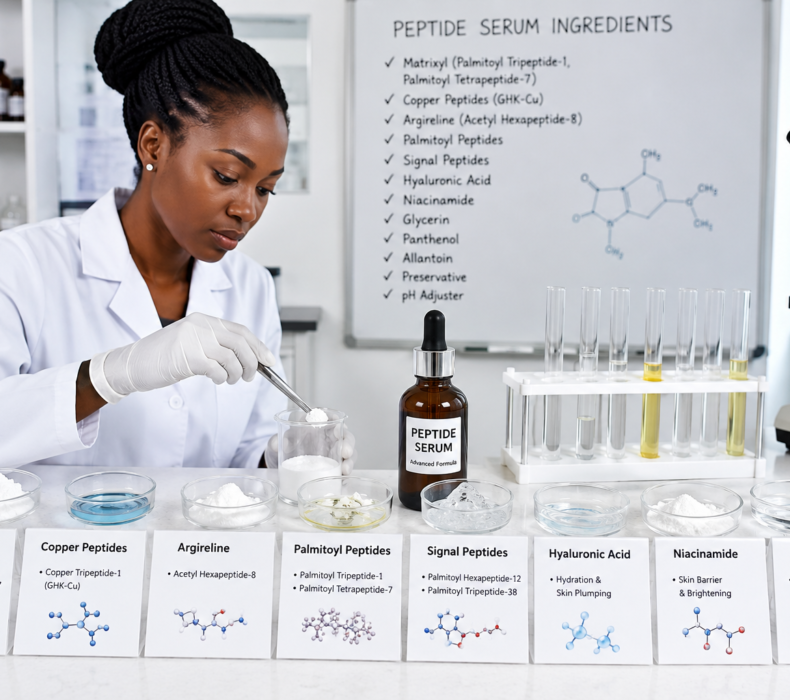
Peptide serums have become increasingly popular in modern skincare, especially among people looking for products that support firmer, smoother, and more youthful-looking skin. But when you look at the ingredient list on a peptide serum, you may find names such as Matrixyl, copper peptides, Argireline, palmitoyl peptides, and signal peptides. What do these ingredients actually do?
Understanding peptide serum ingredients can help you choose a product that better matches your skincare goals. Although many peptide ingredients work in similar ways, different peptides can have different functions, from supporting the skin’s natural collagen processes to improving the appearance of fine lines and helping the skin maintain a healthy barrier.
This guide explains some of the most common peptide ingredients, including Matrixyl, copper peptides, Argireline, and other peptide technologies you may encounter in skincare products.
What Are Peptides in Skincare?
Peptides are short chains of amino acids, which are the building blocks of proteins. The skin naturally contains proteins such as collagen and elastin that contribute to its structure, strength, and elasticity.
In skincare, peptides are used in topical products such as serums, moisturizers, and creams. Different peptides are designed to interact with the skin in different ways.
As the skin ages, the appearance of fine lines, wrinkles, loss of firmness, and uneven texture can become more noticeable. Peptide-based skincare is commonly formulated to support the appearance of smoother, firmer, and healthier-looking skin.
However, not all peptides are identical. Their benefits depend on their molecular structure, concentration, formulation, stability, and how they are delivered in the product.
Why Are Peptides Used in Serums?
Serums are popular delivery formats because they are typically lightweight and can contain concentrated amounts of selected skincare ingredients.
A peptide serum may be formulated to target concerns such as:
- Fine lines and wrinkles
- Loss of skin firmness
- Reduced elasticity
- Uneven skin texture
- Signs of premature-looking aging
- Dull or tired-looking skin
- Skin barrier support
One of the biggest advantages of peptides is that they can be incorporated into different skincare routines and are generally suitable for many skin types when properly formulated.
But the term “peptide serum” covers many different formulations. Looking beyond the front of the bottle and checking the ingredient list can help you understand what you are actually buying.
Matrixyl: One of the Best-Known Peptide Ingredients
Matrixyl is one of the most recognizable names associated with peptide skincare. It is a trademarked family of peptide ingredients used in anti-aging skincare formulations.
Different versions of Matrixyl exist, including Matrixyl 3000 and Matrixyl Synthe’6. These formulations contain different peptide combinations designed for specific cosmetic applications.
What Does Matrixyl Do?
Matrixyl peptides are commonly used in products formulated to improve the appearance of aging skin. They are associated with supporting the skin’s natural processes involved in maintaining its extracellular matrix.
In practical skincare terms, Matrixyl-containing products are often marketed to help improve the appearance of:
- Fine lines
- Wrinkles
- Skin firmness
- Skin smoothness
- Overall skin texture
The important point is that Matrixyl is not a single generic ingredient. When you see Matrixyl on a product description, check the specific type of Matrixyl used.
Matrixyl 3000 Explained
Matrixyl 3000 is a peptide combination that commonly includes Palmitoyl Tripeptide-1 and Palmitoyl Tetrapeptide-7.
These peptides are used in cosmetic formulations designed to support a smoother and more youthful-looking complexion.
Because the peptides are combined into a formulation, Matrixyl 3000 is frequently found in serums and creams targeting visible signs of skin aging.
Matrixyl Synthe’6 Explained
Matrixyl Synthe’6 is another peptide complex used in anti-aging skincare.
Its key peptide is commonly identified as Palmitoyl Tripeptide-38. It is formulated for cosmetic applications involving the appearance of wrinkles and skin texture.
Therefore, when comparing peptide serums, two products may both claim to contain Matrixyl but actually contain different Matrixyl technologies.
Copper Peptides: What Are They?
Copper peptides are another popular category of peptide skincare ingredients.
One of the best-known examples is Copper Tripeptide-1, commonly referred to as GHK-Cu.
GHK is a naturally occurring peptide associated with copper, and Copper Tripeptide-1 is used in cosmetic formulations designed to support the appearance and condition of the skin.
What Are the Benefits of Copper Peptides?
Copper peptide products are commonly formulated to support:
- Skin firmness
- Skin elasticity
- Smoother-looking skin
- Overall skin appearance
- The appearance of healthier, more resilient skin
Copper peptides are particularly interesting because they combine peptide technology with copper, an important trace mineral.
However, more does not necessarily mean better. Using several highly active skincare products simultaneously can sometimes increase irritation, particularly for sensitive skin.
For this reason, introducing a copper peptide serum gradually can be a sensible approach.
Argireline: The “Expression Line” Peptide
Argireline is another well-known peptide used in cosmetic skincare.
Its INCI name is Acetyl Hexapeptide-8, although some formulations may use related naming depending on the specific ingredient technology.
Argireline is especially popular in products targeting the appearance of expression lines.
How Does Argireline Work?
Argireline is often described as a peptide that targets the appearance of wrinkles associated with repeated facial expressions.
Expression lines can become more visible over time because facial muscles repeatedly contract during smiling, frowning, squinting, and other expressions.
Argireline-containing products are therefore commonly marketed for areas where expression lines are noticeable, including:
- Forehead lines
- Lines around the eyes
- Frown lines
- Other expression-related wrinkles
It is important to remember that topical skincare is different from injectable cosmetic treatments. A serum containing Argireline should not be considered equivalent to professional injectable procedures.
Palmitoyl Peptides Explained
You may also see ingredients beginning with Palmitoyl, such as Palmitoyl Tripeptide-1 or Palmitoyl Tetrapeptide-7.
These are examples of lipidated peptides. The palmitoyl component helps modify the peptide’s characteristics and is commonly used in cosmetic formulations.
Palmitoyl peptides are frequently associated with products designed to improve the appearance of fine lines, wrinkles, firmness, and overall skin texture.
They are also important components of some Matrixyl technologies.
Signal Peptides
Signal peptides are designed to send biochemical signals that encourage particular skin processes.
In cosmetic skincare, signal peptides are commonly included in formulations intended to support the appearance of collagen-rich, firmer, smoother skin.
Examples include several palmitoyl peptides used in anti-aging formulations.
The goal is generally not to physically add collagen to the skin. Instead, these ingredients are formulated to support processes associated with the skin’s extracellular matrix.
Carrier Peptides
Carrier peptides have a slightly different purpose.
Instead of primarily acting as signaling ingredients, carrier peptides are associated with transporting or delivering certain trace elements to the skin.
Copper peptides are one of the most familiar examples.
Because copper plays a role in several biological processes, copper-containing peptide ingredients have attracted considerable interest in cosmetic skincare.
Enzyme-Inhibiting Peptides
Another category is enzyme-inhibiting peptides.
These peptides are designed to interact with certain enzymes involved in processes associated with the appearance and structural condition of the skin.
They may be included in formulations targeting visible signs of aging and changes in skin structure.
The terminology can sound complicated, but the main takeaway is simple: different peptides are designed to perform different cosmetic functions.
Peptide Serum Ingredients: What Should You Look For?
When shopping for a peptide serum, don’t focus only on the word “peptide” on the front label.
Instead, check the ingredient list.
Look for specific ingredients such as:
- Acetyl Hexapeptide-8
- Copper Tripeptide-1
- Palmitoyl Tripeptide-1
- Palmitoyl Tetrapeptide-7
- Palmitoyl Tripeptide-38
- Palmitoyl Hexapeptide-12
- Other named peptide complexes
It is also worth looking at the rest of the formula.
A good peptide serum may contain complementary ingredients such as hyaluronic acid, glycerin, ceramides, panthenol, antioxidants, or soothing ingredients.
This can make the overall formulation more useful than simply choosing a product based on the highest number of peptides listed on the packaging.
Peptides vs Collagen: What’s the Difference?
One common question is whether peptide serums contain collagen.
Some peptide serums may contain collagen or collagen-supporting ingredients, but peptides and collagen are not the same thing.
Collagen is a large structural protein, while peptides are smaller chains of amino acids.
Topical collagen is generally used as a moisturizing or film-forming skincare ingredient because collagen molecules are too large to simply penetrate the skin and replace lost structural collagen.
Peptides, on the other hand, are incorporated into formulations for different cosmetic functions, including supporting the appearance of firmer and smoother skin.
How to Use a Peptide Serum
Using a peptide serum is relatively simple.
Step 1: Cleanse Your Face
Start with a gentle cleanser to remove dirt, excess oil, makeup, and other impurities.
Step 2: Apply Your Peptide Serum
Apply a small amount of peptide serum to clean skin according to the manufacturer’s instructions.
Step 3: Follow With Moisturizer
A moisturizer can help maintain hydration and support the skin barrier.
Step 4: Use Sunscreen During the Day
If you are using your peptide serum in the morning, finish your routine with broad-spectrum sunscreen.
Sunscreen is particularly important because ultraviolet exposure is one of the major environmental factors associated with visible skin aging.
Can You Use Peptides Every Day?
Many peptide serums are formulated for daily use, including both morning and evening routines.
However, always follow the directions provided by the manufacturer.
If your skin is sensitive, begin by using the serum a few times per week and gradually increase frequency if your skin tolerates it well.
Peptides are generally considered relatively gentle compared with stronger exfoliating acids and retinoids, but the entire formula matters. Other ingredients included in the serum may influence how your skin responds.
Can Peptides Be Used With Other Skincare Ingredients?
Peptides can often be incorporated into routines containing other skincare ingredients.
For example, a simple routine could include:
Morning:
Cleanser → Peptide Serum → Moisturizer → Sunscreen
Evening:
Cleanser → Peptide Serum → Moisturizer
If you also use ingredients such as retinoids, exfoliating acids, or vitamin C, consider introducing products gradually rather than changing everything at once.
This makes it easier to identify which product may be responsible if irritation develops.
Are Peptide Serums Suitable for All Skin Types?
Peptide serums can be suitable for many different skin types, including normal, dry, oily, combination, and mature skin.
However, individual formulas differ.
If you have oily skin, look for lightweight, non-greasy formulations. If your skin is dry, a peptide serum containing hydrating ingredients such as hyaluronic acid or glycerin may be more appealing.
For sensitive skin, choose a simple formulation and avoid introducing multiple potentially irritating products at the same time.
Always patch-test new skincare products when appropriate and discontinue use if significant irritation occurs.
Matrixyl vs Copper Peptides vs Argireline: Which Is Better?
There isn’t one peptide that is automatically best for everyone.
Matrixyl is popular in formulations targeting the appearance of fine lines, wrinkles, firmness, and skin texture.
Copper peptides are commonly used in formulations focused on skin appearance, resilience, firmness, and overall skin quality.
Argireline is particularly associated with the appearance of expression lines.
Rather than asking which peptide is universally best, consider what your skincare routine is trying to achieve.
Some advanced formulations combine several peptide technologies to provide multiple cosmetic benefits in one product.
What Results Can You Expect From a Peptide Serum?
Peptide serums should be viewed as part of a consistent skincare routine rather than an instant solution for wrinkles.
With regular use, a well-formulated product may help improve the appearance of smoother, firmer, healthier-looking skin.
Results vary depending on the individual, product formulation, concentration, frequency of use, age, skin condition, lifestyle, and other skincare products being used.
Consistency is more important than expecting overnight transformation.
Final Thoughts on Peptide Serum Ingredients
Understanding peptide serum ingredients makes it easier to choose skincare products based on what they actually contain rather than relying entirely on marketing claims.
Matrixyl, copper peptides, Argireline, palmitoyl peptides, signal peptides, and carrier peptides all have different roles in cosmetic formulations. Some are primarily associated with supporting the appearance of firmness and reducing the look of fine lines, while others focus on expression lines or overall skin condition.
When choosing a peptide serum, look beyond the word “peptide.” Examine the specific ingredients, the complete formula, your skin type, and the concerns you want to address.
Most importantly, remember that a good skincare routine is built around consistency. Cleansing, moisturizing, daily sun protection, and carefully selected active ingredients can work together to support healthy, smooth, and youthful-looking skin.
A peptide serum can be a valuable addition to that routine, particularly when you understand exactly what its key ingredients are designed to do.


 Get it on
  Download on the