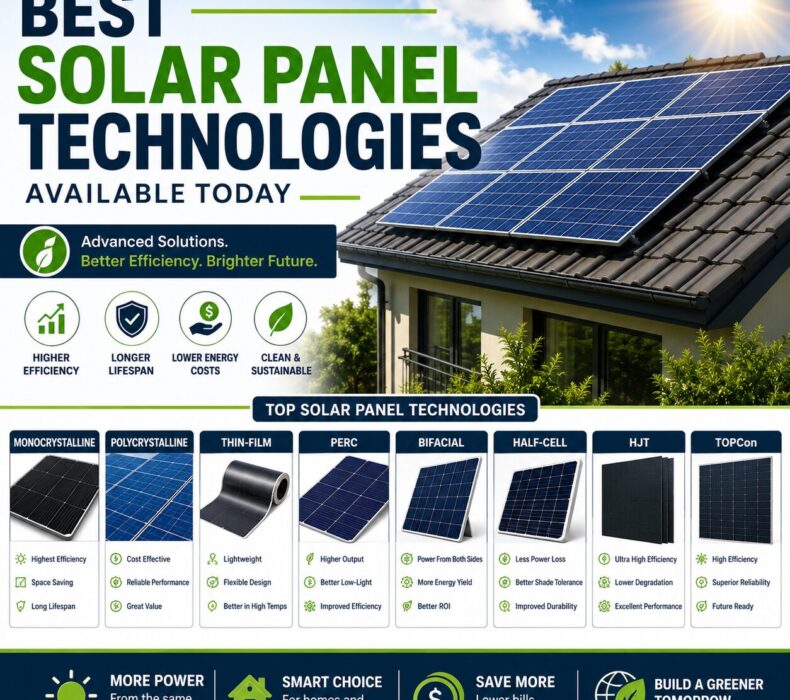
As solar energy adoption continues to grow worldwide, homeowners and businesses are increasingly seeking the Best Solar Panel Technologies Available Today to maximize energy production and long-term savings. Furthermore, advances in solar technology have significantly improved efficiency, durability, and affordability, making solar power a smart investment for both residential and commercial properties.
Whether you want to reduce electricity bills or achieve greater energy independence, understanding the latest solar panel technologies can help you make an informed decision.
Why Solar Panel Technology Matters
Not all solar panels are created equal. Therefore, choosing the right technology can significantly impact energy output, installation costs, and overall system performance.
Moreover, modern solar panels are designed to generate more electricity from the same amount of sunlight. As a result, homeowners can achieve greater energy savings while using less roof space.
Monocrystalline Solar Panels
Monocrystalline solar panels are among the most efficient options available today.
Key Benefits
High energy conversion efficiency
Long lifespan
Excellent performance in limited spaces
Attractive appearance
Manufacturers create these panels using a single silicon crystal structure. This design allows electricity to flow more efficiently through the cells. Higher efficiency means more power generation, even when roof space is limited.
Polycrystalline Solar Panels
Polycrystalline panels remain a popular choice due to their affordability and reliability.
Advantages
Lower initial cost
Good performance in sunny climates
Durable construction
Suitable for residential installations
Thin-Film Solar Panels
Thin-film technology represents a different approach to solar energy generation.
Benefits of Thin-Film Panels
Lightweight design
Flexible installation options
Better performance in high temperatures
Lower manufacturing costs
Additionally, thin-film panels can be installed on surfaces where traditional panels may not be practical.
Nevertheless, they generally require more installation space because their efficiency is lower than crystalline silicon panels.
PERC Solar Panels
Passivated Emitter and Rear Cell (PERC) technology has become increasingly popular in recent years.
Why PERC Panels Stand Out
PERC panels include an additional reflective layer on the rear side of the solar cell. As a result, more sunlight is captured and converted into electricity.
Benefits include:
Improved efficiency
Better low-light performance
Increased energy production
Higher overall system output
Consequently, many manufacturers now incorporate PERC technology into premium solar panel products.
Bifacial Solar Panels
Bifacial solar panels can generate electricity from both the front and back surfaces.
Advantages of Bifacial Technology
Increased energy yield
Better utilization of reflected sunlight
Enhanced long-term performance
Improved return on investment
For example, sunlight reflected from roofs, concrete, or light-colored surfaces can be captured by the rear side of the panel.
Therefore, bifacial systems can produce significantly more energy than traditional panels under suitable conditions.
Half-Cell Solar Technology
Half-cell solar panels use smaller solar cells instead of standard full-size cells.
Key Benefits
Reduced power losses
Improved shade tolerance
Better heat management
Higher overall efficiency
Furthermore, splitting cells into smaller units allows electricity to travel shorter distances within the panel. Consequently, energy losses are minimized.
This technology has become increasingly common in modern high-performance solar modules.
Heterojunction (HJT) Solar Panels
technology combines crystalline silicon with thin-film layers to achieve outstanding efficiency.
Benefits of HJT Panels
Exceptional energy conversion rates
Superior performance in hot climates
Lower degradation rates
Longer lifespan
As solar innovation continues, HJT panels are gaining attention for their ability to maximize energy production in challenging environments.
TOPCon Solar Technology
Tunnel Oxide Passivated Contact (TOPCon) technology is among the latest advancements in the solar industry.
Why TOPCon Is Important
TOPCon panels provide:
Higher efficiency than many conventional panels
Improved durability
Better low-light performance
Enhanced long-term reliability
Consequently, many experts consider TOPCon one of the most promising solar technologies available today.
Smart Solar Panels
Modern solar systems increasingly incorporate smart monitoring features.
Features Include
Real-time performance tracking
Remote system monitoring
Early fault detection
Energy consumption analysis
Therefore, homeowners can easily monitor energy production and optimize system performance through mobile applications and online platforms.
Comparing Solar Technologies
Best for Maximum Efficiency
Monocrystalline Panels
HJT Panels
TOPCon Panels
Best for Budget-Conscious Buyers
Polycrystalline Panels
Thin-Film Panels
Best for Advanced Performance
Bifacial Panels
PERC Panels
Half-Cell Panels
As a result, the ideal technology depends on your energy requirements, installation space, and budget.
Choosing the Right Solar Panel Technology
Before investing in a solar system, consider the following factors:
Available Roof Space
Limited roof space generally favors high-efficiency technologies such as monocrystalline or TOPCon panels.
Budget
If affordability is a priority, polycrystalline panels may offer excellent value.
Climate Conditions
Nigeria’s sunny climate supports most solar technologies. However, advanced options such as HJT and PERC panels may provide superior performance in high temperatures.
Long-Term Goals
Homeowners seeking maximum energy independence may benefit from premium technologies with higher efficiency and longer lifespans.
The Future of Solar Panel Technology
Solar technology continues to advance at a rapid pace. Researchers are developing new materials that can capture more sunlight and improve energy production.
Manufacturers are also focusing on making panels more affordable. Lower production costs are helping more households access solar energy solutions. At the same time, improvements in battery storage are making solar systems even more practical.
These developments are expected to increase adoption across residential and commercial markets. Future solar panels will likely offer greater efficiency, longer lifespans, and better overall value.
Conclusion
The Best Solar Panel Technologies Available Today give homeowners and businesses more opportunities to reduce electricity costs and improve energy independence. Options such as monocrystalline, PERC, TOPCon, bifacial, and HJT panels offer unique advantages for different needs and budgets.













 Get it on
  Download on the