





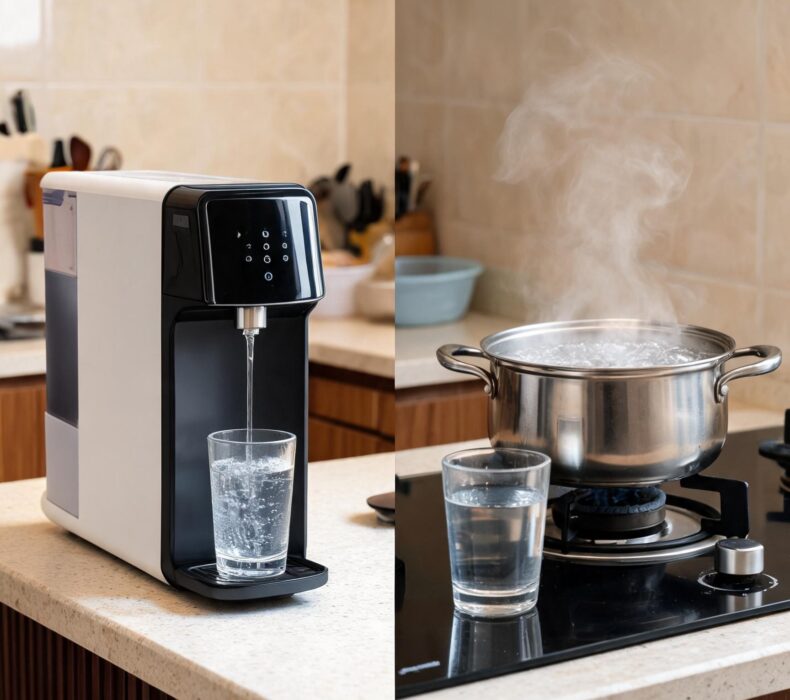
Access to clean drinking water is essential for good household hygiene and everyday wellbeing. However, many families wonder about Water Purifier vs Boiling Water: Which Is Better for Drinking Water when deciding how to treat water at home. Both methods can make water safer in different ways, but they do not remove the same types of contaminants.
Boiling water has been used for generations because it is simple and does not require specialised equipment. On the other hand, water purifiers use different filtration and treatment technologies to address specific impurities. Therefore, understanding the differences can help you choose the most suitable option for your home.
Water Purifier vs Boiling Water: Which Is Better for Drinking Water?
When comparing Water Purifier vs Boiling Water: Which Is Better for Drinking Water, there is no single answer for every household.
Boiling primarily uses heat to inactivate many disease-causing microorganisms. A water purifier, meanwhile, can use filtration or other treatment methods to reduce particular contaminants.
For example, a reverse osmosis purifier can reduce many dissolved substances, while an activated carbon filter can improve taste and odour. Consequently, the better option depends on the quality of your water and the contaminants you need to address.
How Does Boiling Water Work?
Boiling is one of the simplest methods of household water treatment.
When water reaches a sufficient boil, heat can inactivate many bacteria, viruses, and parasites that may cause waterborne illness. Therefore, boiling can be useful when the primary concern is microbiological contamination.
However, boiling does not remove everything from water.
It does not generally remove:
- Dissolved salts
- Many dissolved minerals
- Heavy metals
- Sand and sediment
- Certain chemicals
- Excess hardness
In addition, boiling can leave some dissolved substances concentrated because part of the water evaporates.
Therefore, boiling should not automatically be considered a complete water purification method.
How Does a Water Purifier Work?
A water purifier works by passing water through one or more treatment stages. The exact process depends on the technology used.
For example, a basic filtration system may remove sediment, while a multi-stage purifier can combine several technologies.
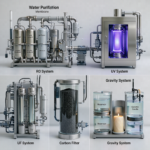
Common water purification methods include:
- Sediment filtration
- Activated carbon filtration
- Reverse osmosis
- Ultraviolet treatment
- Ultrafiltration
- Ceramic filtration
As a result, a purifier can be designed to address different water quality problems.
Water Purifier vs Boiling Water: Key Differences
Understanding the main differences makes the decision easier.
| Feature | Water Purifier | Boiling Water |
|---|---|---|
| Microorganism treatment | Depends on technology | Heat can inactivate many microorganisms |
| Sediment removal | Yes, with suitable filtration | No |
| Dissolved substance reduction | Yes, with technologies such as RO | Generally no |
| Taste improvement | Carbon filters can help | Usually limited |
| Electricity or fuel | Depends on system | Requires heat source |
| Daily convenience | High once installed | Requires repeated heating |
| Maintenance | Filters may need replacement | Cleaning the kettle or pot |
| Treatment range | Depends on purifier type | Mainly microbial treatment |
The comparison shows that each method has strengths. Therefore, the right choice depends on your water source and treatment goals.
Advantages of Boiling Drinking Water
Simple and Affordable
Boiling does not require a sophisticated appliance. A pot, kettle, or other suitable heating device can be enough.
Consequently, it can be accessible to households that do not want to invest in a water purification system.
Helps Treat Microbial Contamination
Boiling can inactivate many harmful microorganisms when performed properly.
Therefore, it can be useful during emergencies or when you are uncertain about the microbiological safety of a water source.
Useful During Temporary Water Problems
If a household purifier stops working, boiling can provide a temporary treatment option for suitable water.
However, it should not be assumed to remove chemical or dissolved contaminants.
Disadvantages of Boiling Water
Although boiling is useful, it has limitations.
It Does Not Remove Most Dissolved Contaminants
Boiling is not designed to filter dissolved salts, metals, or many chemicals.
Therefore, water may still contain unwanted dissolved substances after boiling.
Requires Energy
Repeatedly heating water requires electricity, gas, firewood, or another energy source.
As a result, frequent boiling can increase household energy consumption.
Requires Cooling and Storage
After boiling, water needs to cool before drinking. It also needs to be stored in a clean, covered container.
Otherwise, treated water can become contaminated again.
Advantages of Using a Water Purifier
Removes Different Types of Impurities
A major advantage of a purifier is that different filtration stages can target different contaminants.
For example, sediment filters can remove particles, while activated carbon can help improve taste and odour.
Reverse Osmosis Can Reduce Dissolved Substances
RO systems use a specialised membrane to reduce many dissolved substances.
Therefore, they can be useful for certain types of borehole water and other water sources with high dissolved solids.
Convenient for Daily Drinking
Once installed correctly, a household purifier can provide treated water whenever needed.
Consequently, you do not have to boil water repeatedly throughout the day.
Can Improve Taste and Odour
Some purification systems use activated carbon filtration.
As a result, they can help improve the taste and smell of drinking water.
Disadvantages of Water Purifiers
Water purifiers also have limitations.
Initial Purchase Cost
A good-quality purifier requires an initial investment.
Furthermore, advanced systems such as RO purifiers can cost more than simple filtration units.
Requires Maintenance
Filters and membranes gradually become less effective.
Therefore, they must be replaced or maintained according to the manufacturer’s recommendations.
Not Every Purifier Removes Every Contaminant
This is an important point.
A basic carbon filter cannot perform the same function as an RO system. Similarly, an RO system is not necessarily designed to address every possible water quality problem.
Consequently, buyers should choose a purifier based on water testing rather than marketing claims alone.
Which Is More Cost-Effective?
The answer depends on how frequently you treat water and the equipment available.
Boiling may appear cheaper initially because you do not need to purchase a purifier. However, regular boiling consumes energy.
A water purifier requires an initial purchase and ongoing maintenance. Nevertheless, it can provide treated water conveniently without repeatedly heating water.
Therefore, compare:
- Purchase cost
- Electricity or fuel consumption
- Filter replacement
- Maintenance
- Water usage
- Household drinking-water demand
Looking at the long-term cost gives you a better picture than comparing the purchase price alone.
Can You Boil Purified Water?
Yes, water that has already been purified can be boiled when additional heat treatment is considered necessary.
However, boiling purified water is not automatically required in every situation.
If the purifier is properly maintained and the treated water is microbiologically safe, additional boiling may not provide a meaningful benefit.
Therefore, follow the guidance appropriate to your water source and purification system.
Important Factors to Consider Before Choosing
Know Your Water Source
First, identify where your drinking water comes from.
Borehole water, well water, and public water can have different treatment requirements.
Test the Water
A water quality test can identify problems that are not visible to the naked eye.
For example, clear water can still contain dissolved substances or microorganisms.
Identify the Main Contaminants
Once you know what is in your water, choose a treatment method that can address those contaminants.
Consider Your Budget
Think beyond the purchase price.
A purifier may require replacement filters, servicing, and electricity, while boiling requires an ongoing energy source.
Consider Household Size
A large family may need a higher-capacity purification system.
On the other hand, a smaller household may manage comfortably with a compact purifier or regular boiling.
Water Purifier vs Boiling Water: Which One Should You Choose?
If your primary concern is treating microorganisms and you have a reliable way to heat water, boiling can be useful.
However, if your water contains sediment, unpleasant taste, high TDS, or other dissolved substances, a suitable water purifier may offer broader treatment.
In some situations, combining filtration with disinfection can provide a more comprehensive approach.
Therefore, the best choice should be based on your water quality rather than convenience alone.
Conclusion
The debate over Water Purifier vs Boiling Water: Which Is Better for Drinking Water does not have one universal answer. Boiling is a simple method that can help inactivate many microorganisms, but it does not remove most dissolved contaminants.
Water purifiers, on the other hand, can use different technologies to target sediment, dissolved substances, unpleasant taste, odour, and microorganisms. However, their effectiveness depends on choosing the correct technology and maintaining the system properly.


 Get it on
  Download on the