






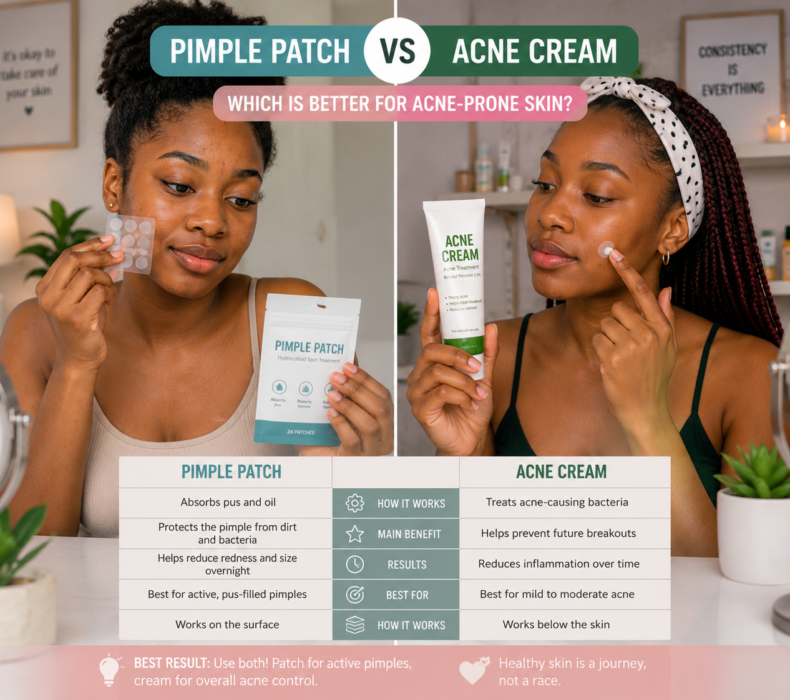
Pimples can appear at the worst possible time, whether you are preparing for an important event, dealing with recurring breakouts, or simply trying to maintain clearer-looking skin. With so many acne treatments available, two popular options often stand out: pimple patches and acne creams.
But which one is actually better for pimples?
The answer depends on the type of pimple you have, the ingredients in the product, your skin type, and what you want the treatment to achieve. Pimple patches are convenient and can protect individual spots, while acne creams can treat acne more broadly and may help prevent future breakouts when used consistently.
In this guide, we compare pimple patches vs acne creams, including how they work, their benefits and limitations, which pimples they are best for, and how to decide which option is right for your skincare routine.
Pimple Patch vs Acne Cream: What Is the Difference?
The main difference between a pimple patch and an acne cream is how and where they are applied.
A pimple patch is a small adhesive treatment placed directly over an individual pimple. Many basic patches use hydrocolloid, a material that absorbs fluid from certain surface-level pimples while creating a protective barrier over the spot. Some newer patches also contain acne-focused ingredients such as salicylic acid.
Acne creams, on the other hand, are usually spread over individual pimples or larger acne-prone areas. Depending on the formulation, they may contain ingredients such as benzoyl peroxide, salicylic acid, adapalene, azelaic acid, or other acne-fighting ingredients.
This means a pimple patch is generally more spot-focused, while an acne cream can be used for spot treatment or broader acne management, depending on the product.
How Do Pimple Patches Work?
Pimple patches are designed to cover individual blemishes. Hydrocolloid patches can absorb fluid from pimples that have come to the surface, while the patch also helps protect the area from touching, picking, and external irritation.
This protective function is one of the biggest advantages of pimple patches.
For example, if you frequently touch or squeeze your pimples, covering a spot with a patch can create a physical reminder to leave it alone. This may help reduce unnecessary irritation caused by picking.
Some medicated pimple patches contain active ingredients. However, not every pimple patch contains the same ingredients, so it is important to read the product label before buying one.
Benefits of Pimple Patches
Pimple patches can offer several advantages:
- They are easy to apply.
- They can protect a pimple from touching and picking.
- Hydrocolloid patches can absorb fluid from suitable surface-level pimples.
- They are convenient for overnight use.
- Some patches are discreet enough to wear during the day.
- They can create a protective barrier over an irritated spot.
- They are useful for targeting individual pimples.
However, pimple patches are not a universal acne treatment. They may be less useful for deep, painful pimples underneath the skin, blackheads, or widespread acne.
How Do Acne Creams Work?
Acne creams work differently depending on their active ingredients.
Benzoyl peroxide, for example, is commonly used to reduce acne-causing bacteria and inflammation. Salicylic acid helps exfoliate the skin and can help unclog pores. Adapalene, a topical retinoid, helps normalize the shedding of skin cells inside pores and is commonly used as part of an acne treatment routine.
Other ingredients, such as azelaic acid, may be used to address acne while also helping with post-inflammatory marks.
Because different acne creams contain different active ingredients, you should not judge all acne creams as if they work in exactly the same way.
Benefits of Acne Cream
An appropriate acne cream may:
- Treat individual pimples.
- Help unclog blocked pores.
- Reduce acne-related inflammation.
- Help manage recurring breakouts.
- Treat a larger acne-prone area.
- Support long-term acne management.
- Address different types of acne depending on its ingredients.
The major advantage of acne cream is that it can be incorporated into a consistent acne-management routine rather than being used only when a single pimple appears.
Pimple Patch vs Acne Cream: Which Works Faster?
Many people want to know which treatment will make a pimple disappear faster.
Unfortunately, there is no single answer.
A hydrocolloid pimple patch may make a surface-level pimple look flatter or less noticeable by absorbing fluid and protecting it. However, this does not mean every pimple will disappear overnight.
Acne creams also require time. Some treatments can improve individual breakouts relatively quickly, while ingredients designed for ongoing acne management generally require consistent use over a longer period.
Your results can depend on:
- The type of acne.
- The severity of the breakout.
- The active ingredient used.
- How frequently you use the treatment.
- Your skin’s sensitivity.
- Whether you are treating one pimple or recurring acne.
Therefore, be cautious about products promising that every pimple will disappear overnight.
Pimple Patch vs Acne Cream for Different Types of Pimples
The type of pimple you have can help determine which option makes more sense.
Pimple Patches for Whiteheads
Pimple patches can be particularly convenient for whiteheads or pimples that have come to the surface.
A hydrocolloid patch can cover the spot and absorb fluid from a suitable surface-level blemish. It can also help prevent you from picking at the pimple.
Acne Cream for Blackheads
Blackheads are caused by clogged pores and are generally not the ideal target for a basic hydrocolloid patch.
An acne treatment containing salicylic acid may be more appropriate because salicylic acid can help exfoliate inside pores and reduce buildup.
For recurring blackheads, a consistent skincare routine may be more useful than relying on pimple patches.
Acne Cream for Deep, Painful Pimples
Deep, painful pimples that develop underneath the skin may not respond well to ordinary hydrocolloid patches because there may be little or no surface fluid for the patch to absorb.
An appropriate acne treatment may be more useful for managing these types of breakouts. If you frequently develop large, painful, or persistent acne, consider speaking with a dermatologist or qualified healthcare professional.
Pimple Patches for Pick-Prone Pimples
If your biggest problem is touching or picking your pimples, a patch can be particularly helpful.
The patch creates a physical barrier between your fingers and the blemish. This does not cure acne by itself, but reducing repeated touching and picking may help prevent additional irritation.
Pimple Patch vs Acne Cream for Acne-Prone Skin
For people with acne-prone skin, the best approach may not be choosing one treatment exclusively.
Instead, you may benefit from combining appropriate products as part of a simple routine.
For example, an acne treatment may be used consistently according to its label, while pimple patches can be reserved for individual surface-level pimples that need protection.
However, using several strong acne treatments at the same time can increase irritation. Introduce new products gradually and avoid unnecessarily combining multiple potentially irritating active ingredients.
Are Pimple Patches Better for Sensitive Skin?
Pimple patches can be appealing to people with sensitive skin because a basic hydrocolloid patch may not expose the entire face to an active acne ingredient.
However, the adhesive itself can irritate some people’s skin. Medicated patches can also contain ingredients that cause dryness or irritation.
If you have sensitive skin, check the ingredient list and consider testing a product on a small area first.
A gentle cleanser, moisturizer, and sunscreen can also help support the skin barrier while you use acne treatments.
Are Acne Creams Better for Oily Skin?
Acne creams can be useful for oily, acne-prone skin, particularly when they contain ingredients designed to address clogged pores or acne.
However, oily skin still needs moisture. Over-drying the skin can lead to irritation and may make your skincare routine harder to tolerate.
Choose products formulated for your skin type and follow the directions on the packaging rather than applying more product than recommended.
Pimple Patch vs Acne Cream: Pros and Cons
| Feature | Pimple Patch | Acne Cream |
|---|---|---|
| Best for | Individual surface-level pimples | Various types of acne |
| Application | Directly over a spot | Spot or larger acne-prone area |
| Convenience | Very convenient | Usually requires a skincare routine |
| Picking protection | Excellent | Limited |
| Deep pimples | Often less useful | May be more appropriate depending on ingredients |
| Blackheads | Limited | Some active ingredients can help |
| Recurring acne | Limited as a standalone treatment | Often more suitable for ongoing management |
| Overnight use | Convenient | Depends on the product |
| Active ingredients | Varies by patch | Varies widely |
Can You Use a Pimple Patch and Acne Cream Together?
In some cases, yes, but you need to consider the specific products.
Applying acne cream underneath a pimple patch is not automatically better. Some medicated patches already contain active ingredients, and layering another acne treatment underneath can increase the risk of irritation.
A simple approach is to follow the instructions for each product. If a patch is intended for clean, dry skin, apply it as directed rather than adding multiple products underneath it.
If you are using prescription acne medication, ask your healthcare professional how to combine it with pimple patches.
How to Use a Pimple Patch Correctly
For best results, follow the product instructions. A typical routine involves:
- Cleanse your face gently.
- Dry the affected area completely.
- Apply the patch directly over the targeted pimple.
- Leave it on for the recommended amount of time.
- Remove it gently.
- Replace it if the product instructions recommend another application.
Avoid applying a patch over dirty, oily, or heavily moisturized skin because this may prevent it from sticking properly.
How to Use Acne Cream Correctly
Acne creams should also be used according to their instructions.
Start with clean, dry skin unless the product directions state otherwise. Apply the recommended amount rather than assuming that more product will produce faster results.
If an acne cream causes excessive burning, swelling, severe redness, or significant irritation, stop using it and seek professional advice.
Some acne treatments can increase sensitivity to sunlight, so daytime sunscreen is an important part of a complete skincare routine.
Common Mistakes to Avoid
Whether you prefer patches or creams, avoid these common mistakes:
Squeezing Pimples
Squeezing can increase irritation and potentially contribute to post-inflammatory marks or scarring.
Using Too Much Acne Treatment
More is not necessarily better. Excessive use of strong active ingredients can damage the skin barrier and cause dryness.
Changing Products Too Frequently
Switching between acne treatments every few days makes it difficult to determine what is working and can increase irritation.
Skipping Moisturizer
Even acne-prone skin needs hydration. A lightweight, non-comedogenic moisturizer can help support the skin barrier.
Forgetting Sunscreen
Sun protection is particularly important when dealing with acne and post-acne marks. Choose a sunscreen that suits your skin type and use it consistently.
So, Which Is Better: Pimple Patch or Acne Cream?
There is no universal winner because pimple patches and acne creams serve different purposes.
If you have an individual surface-level pimple and want something convenient that can protect the area from picking, a pimple patch may be the better choice.
If you have recurring breakouts, clogged pores, blackheads, or multiple pimples, an appropriate acne cream may be more useful as part of a consistent skincare routine.
For many people, the most practical approach is to use an acne treatment as part of their regular routine and keep pimple patches available for individual spots.
Quick Recommendation
Choose a pimple patch if:
- You have an individual surface-level pimple.
- You tend to touch or pick your pimples.
- You want a convenient overnight spot treatment.
- You want to protect an irritated blemish.
Consider an acne cream if:
- You regularly experience breakouts.
- You have multiple acne-prone areas.
- You have clogged pores or blackheads.
- You want a treatment designed for ongoing acne management.
Final Verdict
When comparing pimple patch vs acne cream, neither option is automatically better for everyone.
Pimple patches are excellent for convenience, spot protection, and certain surface-level pimples. Acne creams can offer broader benefits because their active ingredients may target acne, clogged pores, inflammation, or recurring breakouts.
The best choice depends on your specific skin concerns and the ingredients in the product you select.
If you are dealing with occasional pimples, keeping a few pimple patches in your skincare collection can be useful. If acne is frequent, persistent, painful, or leaving scars, a consistent skincare routine and professional advice may be more appropriate.
Most importantly, avoid picking your pimples, introduce active ingredients carefully, moisturize your skin, and use sunscreen during the day. With the right approach, you can manage breakouts while protecting your skin barrier.
Frequently Asked Questions
Is a pimple patch better than acne cream?
Not necessarily. Pimple patches are useful for individual surface-level pimples and protecting spots from picking, while acne creams can be more suitable for recurring or widespread acne depending on their active ingredients.
Can pimple patches remove pimples overnight?
A pimple patch may make some surface-level pimples look less swollen or noticeable by morning, but results vary. It should not be considered a guaranteed overnight cure for acne.
Can I use a pimple patch every day?
Many pimple patches can be used regularly according to their product instructions. However, monitor your skin for irritation, especially if the patch contains active ingredients or you are sensitive to adhesives.
Should I put acne cream under a pimple patch?
Not automatically. Check the instructions for both products. Combining treatments can increase irritation, particularly when the patch already contains acne-fighting ingredients.
What is best for stubborn pimples?
The appropriate treatment depends on the type and severity of the acne. Persistent, painful, deep, or scarring acne may require professional assessment rather than repeated use of over-the-counter spot treatments.
What should I use after a pimple patch?
After removing the patch, gently cleanse the area if necessary and continue with a simple skincare routine. A gentle moisturizer can help support the skin barrier. During the day, apply sunscreen.






 Get it on
  Download on the