






Introduction
When it comes to sourcing cleaning products and equipment, businesses face a critical decision:
Should you choose local cleaning brands or go for international options?
This question is especially relevant in markets like Nigeria, where both local manufacturers and global brands compete for attention.
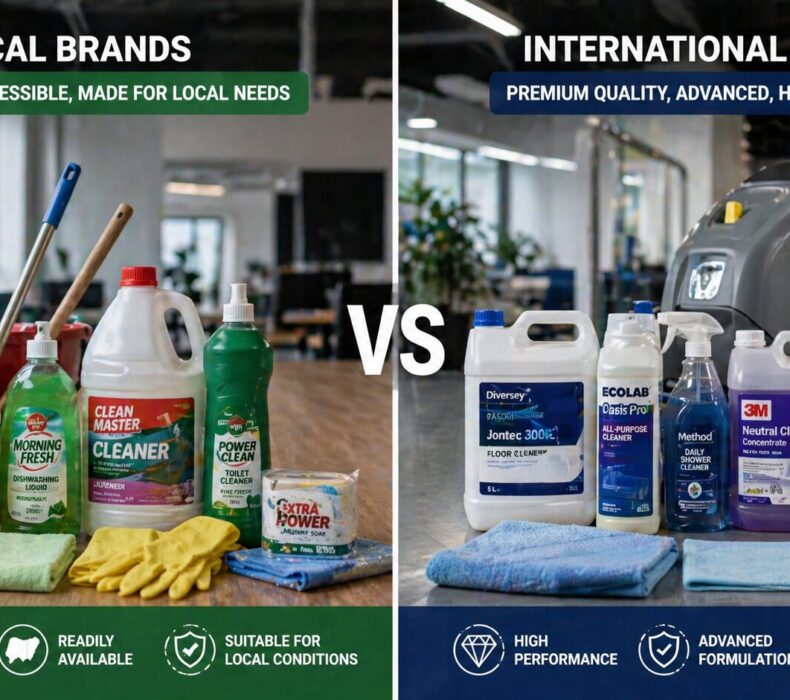
On one hand, international brands are often associated with advanced technology and premium quality. On the other hand, local brands offer affordability, accessibility, and market-specific solutions.
But which option truly delivers better value for your business?
In this comprehensive guide, we’ll break down the local vs international cleaning brands debate, comparing them across key factors like cost, quality, availability, and performance—so you can make the best decision.
🧠 Understanding the Two Categories
🟢 Local Cleaning Brands
These are products manufactured or distributed within Nigeria.
Key characteristics:
- Affordable pricing
- Easy availability
- Designed for local conditions
- Faster delivery and restocking
🔵 International Cleaning Brands
These are imported products from global manufacturers.
Key characteristics:
- Advanced formulations
- Strong brand reputation
- Higher cost
- Often considered premium
💰 1. Cost Comparison
Local Brands:
- Lower upfront cost
- Reduced shipping expenses
- Affordable for startups
International Brands:
- Higher purchase cost
- Import duties and logistics
- Premium pricing
👉 Winner: Local brands for affordability
However, cost alone does not determine value.
⚙️ 2. Product Quality and Performance
International Brands:
- Often tested to global standards
- Consistent quality
- Advanced formulations
Local Brands:
- Improving quality over time
- Some variability between manufacturers
- Designed for local use cases
👉 Winner: International brands (slight edge)
But many local brands are closing the gap significantly.
🧪 3. Suitability for Local Environment
Local Brands:
- Designed for Nigerian conditions
- Effective against local dirt types
- Adapted to water quality and climate
International Brands:
- May not always suit local conditions
- Sometimes require adjustments
👉 Winner: Local brands
📦 4. Availability and Supply Chain
Local Brands:
- Easily accessible
- Faster restocking
- Available in local markets
International Brands:
- Possible delays
- Stock shortages
- Dependence on imports
👉 Winner: Local brands
🔧 5. Maintenance and Support (For Equipment)
Local Suppliers:
- Easier access to spare parts
- Faster repair services
- Local technical support
International Brands:
- Limited service centers
- Expensive spare parts
- Longer repair time
👉 Winner: Local brands
🧠 6. Innovation and Technology
International Brands:
- Strong R&D investment
- Cutting-edge cleaning solutions
- Advanced machinery
Local Brands:
- Gradually adopting innovation
- Focus on practicality
👉 Winner: International brands
🏢 7. Business Image and Perception
International Brands:
- Perceived as premium
- Enhances brand image
Local Brands:
- Seen as cost-effective
- Growing reputation
👉 Winner: Depends on business positioning
🌍 8. Economic Impact
Choosing local brands supports:
- Nigerian businesses
- Job creation
- Economic growth
👉 Many businesses now prioritize local sourcing.
🧽 9. Real-World Industry Insight
Companies like Cleaneat Integrated Services often adopt a hybrid approach:
- Use local products for routine cleaning
- Use international products for specialized tasks
Similarly, suppliers like Neatstore provide access to both categories, helping businesses choose what works best.
Professional providers like NeatSpace Cleaning Company also combine tools and products strategically to achieve high-quality results.
👉 This balanced approach maximizes efficiency and cost-effectiveness.
📊 10. Cost vs Value Analysis
Local Brands:
- Lower cost
- Moderate performance
- High accessibility
International Brands:
- Higher cost
- High performance
- Limited accessibility
👉 The best option depends on your business needs.
🏭 11. Industry-Specific Recommendations
Offices:
- Local products are sufficient
Hotels:
- Mix of local and international
Hospitals:
- Prefer international-grade disinfectants
Industrial facilities:
- Use high-performance international equipment
⚖️ 12. When to Choose Local Brands
Choose local brands if:
- You have a tight budget
- You need quick supply
- You operate in high-volume cleaning
- You want cost efficiency
⚖️ 13. When to Choose International Brands
Choose international brands if:
- You need premium quality
- You handle specialized cleaning
- Brand image is critical
- You require advanced equipment
🧠 14. Hybrid Strategy: The Smart Choice
The most effective strategy is often a combination of both.
Example:
- Local detergents for daily cleaning
- International disinfectants for deep cleaning
- Local tools + imported machines
👉 This approach balances cost and quality.
⚠️ Common Mistakes to Avoid
- Assuming expensive means better
- Ignoring product compatibility
- Buying based on brand name alone
- Not testing products
👉 Smart evaluation is key.
🔐 15. How to Choose the Right Brand
Checklist:
- Check product quality
- Compare cost per use
- Evaluate supplier reliability
- Test before bulk purchase
- Consider long-term value
👉 Always make data-driven decisions.
🧾 Conclusion
So, which is better—local or international cleaning brands?
👉 There is no one-size-fits-all answer.
- Local brands offer affordability, accessibility, and practicality
- International brands offer premium quality and innovation
👉 The smartest choice for most businesses is a hybrid approach, combining the strengths of both.
By balancing cost, performance, and availability, you can create a cleaning system that delivers maximum efficiency and long-term value.







 Get it on
  Download on the