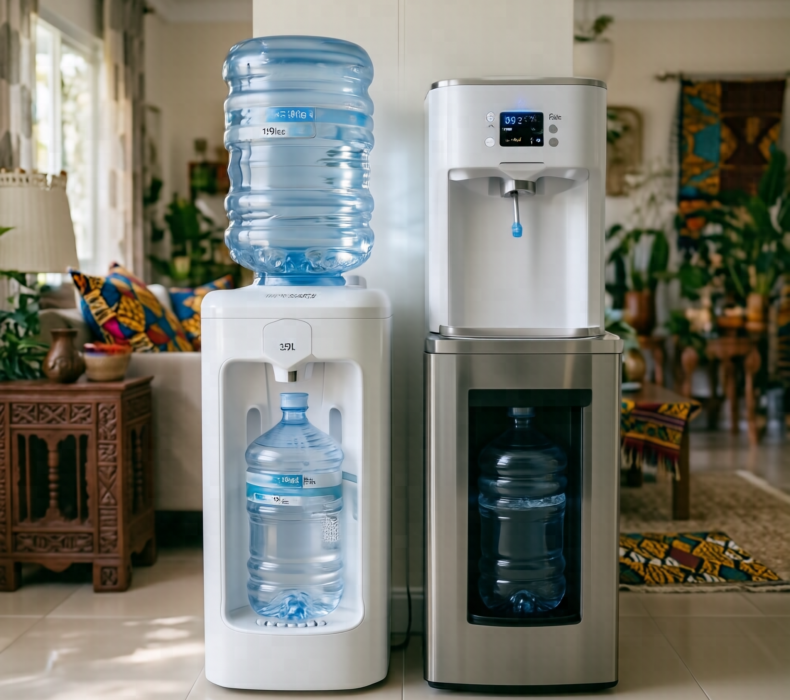
Choosing between Bottom Loading water dispensers vs Top Loading Water Dispensers can be challenging when both options offer convenient access to drinking water. Although they perform the same basic function, their designs are quite different. A top-loading dispenser places the water bottle above the unit, while a bottom-loading model keeps the bottle inside a lower compartment.
Therefore, understanding the differences can help you choose a dispenser that suits your home, office, budget, and daily water consumption.
What Is a Top Loading Water Dispenser?
A top-loading water dispenser has the water bottle positioned on top of the appliance. Gravity allows water to flow from the bottle into the internal reservoir.
This design has been popular for many years because it is straightforward and easy to understand. In addition, top-loading dispensers are available in many sizes and price ranges.
However, replacing the bottle can require some physical effort because a full water container needs to be lifted onto the top of the dispenser.
What Is a Bottom Loading Water Dispenser?
A bottom-loading water dispenser places the water bottle inside a compartment at the bottom of the appliance.
Instead of relying entirely on gravity, the dispenser uses a pump to move water from the bottle into the internal reservoir.
As a result, replacing a water bottle can be much easier. You simply open the lower compartment, position the bottle correctly, and connect the water line according to the manufacturer’s instructions.
Bottom Loading Water Dispensers vs Top Loading Water Dispensers: Key Differences
This is one of the biggest differences between the two designs.
Top-loading models require you to lift the water bottle onto the appliance. A full bottle can be heavy, making this task uncomfortable for some users.
On the other hand, bottom-loading models allow you to place the bottle on the floor inside the lower compartment.
Winner: Bottom loading
2. Overall Convenience
Both designs provide convenient access to drinking water. However, bottom-loading models can be easier to use because the bottle is hidden inside the cabinet.
Additionally, users do not need to repeatedly lift heavy bottles.
Top-loading models are still convenient, especially for households that do not mind replacing bottles manually.
Winner: Bottom loading
3. Price
Top-loading dispensers are generally available across a wider range of affordable options.
Bottom-loading models can cost more because their design requires additional components, such as a pump and enclosed bottle compartment.
Therefore, buyers working with a tight budget may find top-loading models more attractive.
Winner: Top loading
4. Appearance
Bottom-loading dispensers often have a cleaner and more modern appearance because the water bottle is hidden inside the appliance.
Top-loading models display the bottle above the dispenser. Although this design is practical, some buyers may prefer the more streamlined appearance of bottom-loading models.
Winner: Bottom loading
5. Ease of Monitoring Water Level
Top-loading dispensers have an obvious advantage here.
Because the bottle is visible, you can easily see how much water remains. Consequently, it is easier to know when you need to replace the bottle.
With a bottom-loading model, you may need to check inside the cabinet or rely on an indicator light.
Winner: Top loading
6. Maintenance
Both types require regular cleaning and proper maintenance.
Top-loading models have relatively straightforward water-flow systems. Bottom-loading models, meanwhile, contain additional pumping components that may require attention if a problem develops.
Nevertheless, maintenance requirements vary by model. Therefore, always follow the manufacturer’s cleaning and servicing instructions.
Winner: Top loading for simplicity
7. Water Pump
A bottom-loading dispenser needs a pump to move water upward from the bottle.
This adds another mechanical component to the appliance. If the pump develops a fault, it can affect water dispensing.
Top-loading models rely primarily on gravity, so they do not require the same pumping mechanism.
Winner: Top loading for simpler operation
8. Safety and Accessibility
Bottom-loading dispensers can be easier to use because the heavy bottle stays at floor level.
This can be useful for households where lifting large bottles is difficult.
Furthermore, many modern dispensers of both types include child safety locks for hot water.
Winner: Bottom loading for bottle handling
Comparison at a Glance
Feature
Bottom Loading
Top Loading
Bottle replacement
Easier
Requires lifting
Purchase price
Usually higher
Usually more affordable
Appearance
Modern and concealed
Traditional and visible
Water-level visibility
Lower
Excellent
Pump required
Yes
Usually no
Maintenance
More components
Simpler system
Space efficiency
Good
Good
Everyday convenience
Excellent
Good
Best for
Convenience-focused homes
Budget-conscious buyers
Which One Uses More Electricity?
The loading design itself does not automatically determine electricity consumption.
Instead, energy use depends mainly on the cooling and heating systems, insulation, operating time, and overall appliance design.
Therefore, a bottom-loading dispenser is not necessarily less or more energy efficient than a top-loading model simply because of its loading mechanism.
If electricity consumption is important to you, check the manufacturer’s power rating and energy information before buying.
Which Is Better for Nigerian Homes?
Both designs can work well in Nigerian homes. The right option depends on your household’s priorities.
A top-loading dispenser may be suitable if you want a straightforward appliance at a potentially lower purchase price. It can also make it easy to monitor the water level.
However, a bottom-loading model may be more convenient if you regularly replace large water bottles and want to avoid lifting them.
Furthermore, households with older adults or anyone who finds heavy lifting difficult may appreciate the easier bottle-loading design.
Which Is Better for Small Apartments?
Space is an important factor in smaller homes.
Both top- and bottom-loading dispensers can have compact designs. However, you should consider the space required to open the bottle compartment or replace a top-mounted bottle.
A bottom-loading model may provide a cleaner appearance because the bottle is hidden. Nevertheless, always measure your available floor space before purchasing.
Which Is Better for Offices?
Both types can work well in offices.
Top-loading models may be attractive for offices focused on affordability and simple maintenance. Meanwhile, bottom-loading dispensers can provide a more professional appearance and make bottle replacement easier.
If the dispenser will be used frequently by many employees, convenience may justify the higher initial cost of a bottom-loading model.
Hot and Cold Functions
Whether you choose top loading or bottom loading, check the temperature functions offered by the specific model.
Many dispensers provide hot and cold water, while some also provide room-temperature water.
A hot-water safety lock is particularly important in homes and offices where children may have access to the appliance.
Additionally, check the cooling capacity if your household consumes large amounts of chilled water.
What About Filtration?
Neither loading style automatically means that the dispenser includes water filtration.
Some top-loading and bottom-loading models include filtration systems, while others simply dispense water from a bottle.
Therefore, if filtration is important to you, check the specific model’s filter technology and replacement requirements.
Also, remember that a filtration system should not be assumed to make every water source safe. Always use an appropriate water source and follow the manufacturer’s instructions.
Pros and Cons of Bottom Loading Dispensers
Advantages
Easier bottle replacement
No need to lift heavy bottles onto the unit
Modern appearance
Bottle is hidden inside the cabinet
Convenient for many households
Disadvantages
Usually costs more
Requires a pump
More components can mean more potential maintenance
Water level may be harder to see
Pros and Cons of Top Loading Dispensers
Advantages
Often more affordable
Simple and familiar design
Easy to monitor water level
Gravity-fed water flow
Generally straightforward to maintain
Disadvantages
Requires lifting the water bottle
Bottle remains visible
Can be inconvenient for users who struggle with heavy lifting
A top-loading water dispenser is a strong choice for buyers who prioritize affordability, simple operation, easy water-level monitoring, and straightforward maintenance.
Meanwhile, a bottom-loading water dispenser is ideal for people who value convenience, easier bottle replacement, and a cleaner modern appearance.
Ultimately, your budget, household needs, available space, and preferred level of convenience should determine your choice. By comparing these factors carefully, you can select a water dispenser that provides reliable access to drinking water without unnecessary expense.












 Get it on
  Download on the