






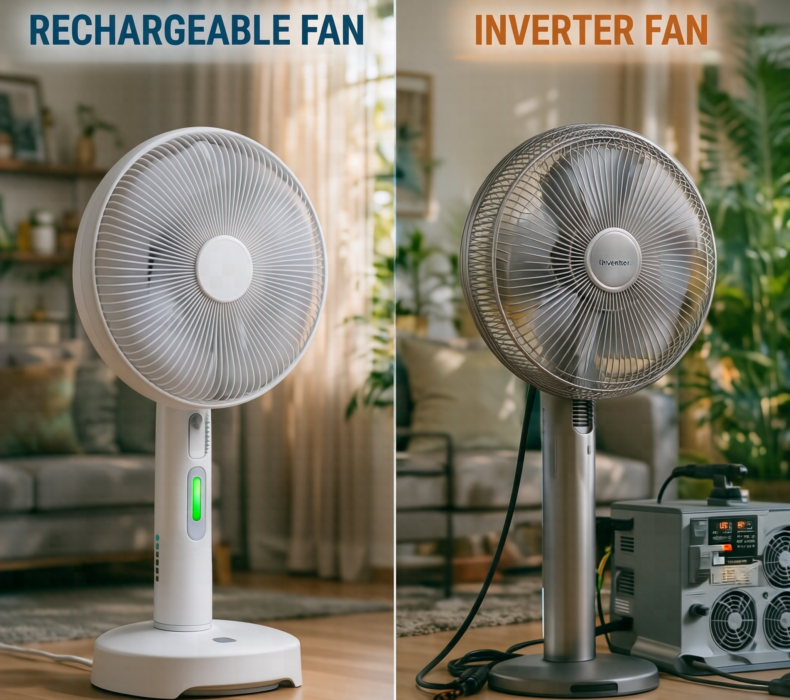
Choosing between a Rechargeable fan vs inverter fan can be confusing, especially when you want reliable cooling during power outages. Both options can keep your home comfortable when regular electricity is unavailable. However, they work differently and offer different advantages.
A rechargeable fan has a built-in battery that stores electricity for later use. Therefore, you can charge it when power is available and continue using it after the electricity goes off. An inverter fan, on the other hand, can refer to a fan designed to run from an inverter power system or, in some cases, a fan with an energy-efficient inverter or DC motor.
Consequently, the better option depends on your electricity supply, budget, room size, expected usage, and whether you already own an inverter system.
Rechargeable Fan vs Inverter Fan: What Is the Difference?
The easiest way to understand the Rechargeable fan vs inverter fan comparison is to look at how each system gets its power.
A rechargeable fan contains a built-in rechargeable battery. When mains electricity is available, you charge the fan. Once the battery is charged, the fan can operate without being connected to a wall socket.
An inverter-powered fan does not necessarily have its own large internal battery. Instead, it receives power from an inverter system that converts stored battery power into electricity that household appliances can use.
For example, a home may have an inverter connected to solar panels and batteries. During a power outage, the inverter can supply electricity to selected appliances, including a compatible fan.
There is also another type of product sometimes called an inverter fan. These fans may use an inverter or variable-speed motor designed for efficient operation. Therefore, buyers should always check the manufacturer’s specifications to understand exactly what “inverter fan” means for the particular model.
What Is a Rechargeable Fan?
A rechargeable fan is a fan with a built-in battery.
The battery is charged using mains electricity or, depending on the model, another compatible charging source. After charging, the fan can continue operating when mains electricity is unavailable.
Many rechargeable fans are designed specifically for situations where power interruptions occur.
Common features include:
- Built-in rechargeable battery
- Multiple speed settings
- LED emergency light
- USB charging port
- Remote control
- Timer
- Battery indicator
- Oscillation
- Adjustable speed
- Solar charging compatibility on selected models
Because the battery is integrated into the appliance, rechargeable fans are generally easy to use.
Simply charge the fan, switch it on when needed, and recharge it after the battery becomes low.
What Is an Inverter Fan?
The term “inverter fan” can have more than one meaning.
In many Nigerian homes, an inverter fan may refer to a conventional fan that receives power from a home inverter system during a power outage.
For example, imagine that you have a 1.5kVA inverter connected to a suitable battery bank. When public electricity goes off, the inverter can supply power to selected appliances. If your fan is connected to that system, it can continue operating.
However, some manufacturers also use the term “inverter fan” for fans with inverter-based or variable-speed motor technology. Such fans may adjust their motor speed more efficiently instead of simply switching between fixed speed levels.
Therefore, before buying an inverter fan, ask the seller exactly what type of inverter technology the product uses.
How Does a Rechargeable Fan Work?
A rechargeable fan uses a battery to store electrical energy.
When electricity is available, the internal battery charges. Once charged, the battery supplies power to the fan motor.
For example:
Mains electricity → Fan charger → Internal battery → Fan motor
When there is a power outage, the fan switches to battery operation.
This makes rechargeable fans particularly useful in areas where electricity supply is unreliable.
Moreover, because the battery is already built into the fan, you do not need a separate inverter installation simply to operate the fan.
How Does an Inverter-Powered Fan Work?
An inverter-powered fan uses electricity supplied by an inverter system.
A basic backup arrangement may look like this:
Solar panels or mains electricity → Battery → Inverter → Fan
When public electricity is available, the system can charge the battery.
When power goes off, the battery provides stored energy to the inverter. The inverter then converts the battery’s DC electricity into AC electricity that compatible household appliances can use.
Consequently, one inverter system can potentially power more than just a fan.
Depending on its capacity, the same system may supply power to lights, televisions, routers, computers, refrigerators, and other carefully selected appliances.
Rechargeable Fan vs Inverter Fan: Battery Capacity
Battery capacity is important for both options, although the systems are different.
A rechargeable fan usually has a relatively small built-in battery designed specifically for operating the fan.
An inverter system, however, can have a much larger battery bank.
Therefore, an inverter system may provide longer backup power, especially when it has sufficient battery capacity.
However, there is an important consideration.
If you connect several appliances to the inverter, they all draw power from the same battery. Consequently, the more appliances you use, the faster the battery can discharge.
With a rechargeable fan, the battery is dedicated mainly to the fan and its built-in features.
Rechargeable Fan vs Inverter Fan: Runtime
Runtime is one of the biggest considerations when choosing between the two.
A rechargeable fan may run for several hours depending on:
- Battery capacity
- Fan speed
- Motor efficiency
- Battery age
- LED light usage
- USB charging
- Fan size
Running the fan at a higher speed generally uses more energy. Therefore, a fan may last longer on low speed than on high speed.
An inverter-powered fan can potentially run for a much longer period if the inverter battery bank is sufficiently large.
However, runtime depends on the total load connected to the inverter.
For example, if the inverter is powering a fan, television, lights, router, and refrigerator at the same time, the battery will discharge faster than if it is powering only the fan.
Which Is More Convenient?
For simple cooling during power outages, a rechargeable fan is usually more convenient.
You do not need to calculate inverter capacity or install a separate backup system.
You simply charge the fan and use it when necessary.
An inverter system, however, requires more planning.
You need to consider:
- Inverter capacity
- Battery capacity
- Wiring
- Installation
- Connected appliances
- Battery charging
- System maintenance
Therefore, a rechargeable fan is usually easier for someone who only needs backup cooling.
On the other hand, an inverter system can be more useful for an entire household that wants backup power for several appliances.
Which Is More Affordable?
The answer depends on what you are comparing.
A rechargeable fan generally has a lower initial cost because the battery and charging system are already integrated into the appliance.
An inverter system can require a larger initial investment because you may need:
- Inverter
- Battery
- Installation
- Cables
- Protective devices
- Solar panels, if applicable
Therefore, if your only goal is to keep a fan running during power outages, buying a rechargeable fan may be more economical.
However, if you already have an inverter system, using a suitable fan with that system may make more sense.
Rechargeable Fan vs Inverter Fan: Energy Consumption
Energy consumption depends on the specific fan and power system.
Rechargeable fans generally use relatively low power, especially compact DC-powered models.
An inverter system also has conversion losses because energy passes through the battery and inverter before reaching the appliance.
However, modern inverter systems and efficient fans can reduce unnecessary energy consumption.
Therefore, do not judge energy efficiency simply by whether a fan is rechargeable or inverter-powered.
Instead, check the actual power rating of the fan and the efficiency of the complete backup system.
Which One Is Better During Power Outages?
For short power outages, a rechargeable fan can be an excellent choice.
For example, if electricity usually returns within a few hours, a fully charged rechargeable fan may provide enough cooling until power is restored.
However, for longer outages, an inverter system may provide greater flexibility.
An adequately sized inverter can power the fan while also supplying selected lights, electronics, and other essential appliances.
Consequently, your typical outage duration should influence your decision.
Rechargeable Fan vs Inverter Fan for Nigerian Homes
Power supply conditions are an important factor for Nigerian households.
Some homes experience short interruptions, while others deal with longer periods without electricity.
For a household that mainly wants personal cooling, a rechargeable fan can be a practical solution.
For a household that already uses solar panels and batteries, connecting a suitable fan to the inverter may be more convenient.
Furthermore, homes with several essential appliances may benefit more from a properly designed inverter system.
Therefore, the best option depends on the size of your backup-power needs.
Rechargeable Fan vs Inverter Fan for Bedrooms
Bedrooms have specific cooling requirements.
A rechargeable fan can be convenient because it does not require a separate power system. You can charge it during the day and use it at night if electricity goes off.
Look for features such as:
- Quiet operation
- Timer
- Remote control
- Multiple speed levels
- Oscillation
- Good battery runtime
- Adjustable airflow
An inverter-powered fan can also work well in a bedroom if your home already has an inverter system.
In fact, an inverter system can be useful if you want to power other bedroom appliances during an outage.
Rechargeable Fan vs Inverter Fan for Living Rooms
Living rooms are usually larger than bedrooms, so airflow coverage becomes important.
A powerful rechargeable standing fan can provide good airflow. However, its battery capacity limits how long it can operate without being recharged.
An inverter-powered fan may be more suitable for longer periods if your inverter battery bank has enough capacity.
A ceiling fan connected to an inverter system can also circulate air across a larger room.
Therefore, consider room size and backup duration together.
Rechargeable Fan vs Inverter Fan for Offices
For a small home office, a rechargeable table or standing fan may be enough.
It can provide personal cooling without requiring a complete backup-power system.
However, a business office with several employees may benefit from an inverter system because the same backup system can power fans, computers, networking equipment, lighting, and other essential devices.
Nevertheless, the total inverter load must be calculated carefully.
Which Is Better for Shops?
For a small shop, a rechargeable fan may be practical because it is easy to move and does not require complicated installation.
For larger commercial spaces, an inverter system may provide greater flexibility.
However, businesses should consider the cost of the inverter, batteries, maintenance, and electricity needs before investing.
Which Is Better for Long Power Outages?
If your area frequently experiences long power outages, an inverter system can provide a more comprehensive solution.
A large battery bank can store significantly more energy than the small battery inside a typical rechargeable fan.
However, this does not automatically make an inverter system the better choice.
The system costs more and requires more planning.
Therefore, if you only need cooling, a rechargeable fan may still be the simpler option.
Rechargeable Fan vs Inverter Fan: Solar Compatibility
Solar power can work with both options, depending on the design.
Some rechargeable fans are designed to accept solar charging directly or through compatible solar charging equipment.
An inverter system can also be integrated with solar panels.
A typical solar inverter setup may work like this:
Solar panels → Charge controller/inverter system → Battery → Household appliances
During daylight hours, solar energy can charge the batteries. Later, stored energy can be used to power appliances.
Therefore, if you already have a solar power system, an inverter-powered fan can be a practical addition.
Maintenance Differences
Rechargeable fans generally require less maintenance.
You mainly need to:
- Clean the blades
- Clean the grille
- Check the charging cable
- Keep the fan dry
- Follow battery-care instructions
However, the internal battery will eventually lose capacity.
Inverter systems require more attention.
You may need to monitor:
- Battery condition
- Inverter performance
- Connections
- Ventilation
- Cables
- Solar panels
- System load
Therefore, rechargeable fans usually have a simpler maintenance routine.
Rechargeable Fan vs Inverter Fan: Portability
Portability is another major difference.
A rechargeable fan can usually be moved from one room to another without disconnecting a power system.
For example, you can use it in the bedroom at night and move it to the living room during the day.
An inverter-powered fan is less flexible if it is connected to a fixed household electrical system.
However, a portable fan can still be powered from an inverter if you have a suitable connection.
Which One Is Better for Students?
Students living in hostels or rented apartments may find rechargeable fans more convenient.
They are easy to move, simple to charge, and do not require permanent installation.
A rechargeable table fan can be particularly useful for studying.
However, if the accommodation already has a reliable inverter or solar system, using a compatible fan with that system may be more practical.
Which One Is Better for Families?
For a family home, the decision depends on how much backup power is needed.
If only one room needs cooling during outages, a rechargeable fan may be enough.
If several rooms need fans and the family also wants lighting, television, internet equipment, and other appliances during outages, an inverter system can provide greater flexibility.
Therefore, families should consider their total backup-power requirements rather than focusing on the fan alone.
Advantages of Rechargeable Fans
Rechargeable fans offer several benefits.
Easy to Use
They are simple to operate. Charge the battery and use the fan when necessary.
Portable
You can move the fan between rooms.
Useful During Power Outages
The internal battery allows the fan to continue operating when mains electricity fails.
Lower Initial Investment
You generally do not need to buy a separate inverter and battery system.
Additional Features
Many models include LED lights, USB charging, remote controls, timers, and multiple speeds.
Suitable for Small Spaces
Compact rechargeable fans can be useful in bedrooms, offices, study areas, and shops.
Disadvantages of Rechargeable Fans
Despite their advantages, rechargeable fans also have limitations.
Limited Battery Runtime
The fan can only operate as long as its battery has sufficient charge.
Battery Aging
Rechargeable batteries gradually lose capacity over time.
Charging Time
The fan needs to be recharged before or after extended use.
Limited Backup Capacity
A rechargeable fan normally cannot provide backup power to other household appliances.
Replacement Battery Costs
Eventually, the internal battery may need replacement.
Advantages of Inverter-Powered Fans
An inverter system can provide several benefits.
Longer Backup Potential
A properly sized battery bank can provide power for extended periods.
Multiple Appliances
One inverter system can potentially power several appliances.
Solar Integration
Inverter systems can be integrated with solar panels.
Whole-Home Backup
Depending on the system size and installation, an inverter can support essential household circuits.
Flexible Appliance Selection
You are not limited to using a fan with a built-in battery.
Disadvantages of Inverter-Powered Fans
An inverter system also has disadvantages.
Higher Initial Cost
The complete system can cost significantly more than a rechargeable fan.
Installation Required
Professional installation may be necessary.
Battery Maintenance
Battery condition affects backup performance.
Load Management
You must ensure that the appliances connected to the inverter do not exceed its capacity.
More Components
There are more components that can potentially require maintenance or replacement.
Rechargeable Fan vs Inverter Fan: Comparison Table
| Feature | Rechargeable Fan | Inverter-Powered Fan |
|---|---|---|
| Built-in battery | Yes | Usually no |
| Separate inverter required | No | Yes |
| Portability | Excellent | Depends on setup |
| Installation | Minimal | Usually required |
| Backup for other appliances | No | Yes |
| Initial cost | Usually lower | Usually higher |
| Maintenance | Relatively simple | More involved |
| Solar integration | Some models | Excellent with suitable system |
| Power outage use | Yes | Yes |
| Battery capacity | Usually limited | Can be much larger |
| Best for | Personal or room cooling | Wider household backup |
Which Is More Energy Efficient?
There is no universal winner.
A rechargeable fan may use relatively little electricity because it is often designed around a low-power battery and motor.
However, the complete energy path also matters.
When using an inverter, electricity stored in the battery passes through the inverter before reaching the fan. Some energy is lost during this conversion.
Therefore, an efficient DC rechargeable fan may be very economical for personal cooling.
On the other hand, a highly efficient inverter system can still be an excellent option when it is powering several essential appliances.
Which One Should You Buy?
Choose a rechargeable fan if:
- You mainly need backup cooling.
- You experience short or moderate power outages.
- You want a portable appliance.
- You have a limited budget.
- You do not want installation work.
- You need cooling in one or two rooms.
- You want additional features such as an LED light or USB charging.
Choose an inverter-powered fan if:
- You already have an inverter system.
- You want backup power for several appliances.
- You experience long power outages.
- You have or plan to install solar power.
- You need to operate multiple fans.
- You want a larger household backup solution.
What to Check Before Buying a Rechargeable Fan
Before purchasing, check the following:
Battery Capacity
A larger battery can provide longer operation, although actual runtime varies.
Runtime
Check how many hours the manufacturer claims the fan can operate at different speeds.
Charging Time
A fan that charges quickly can be more convenient.
Motor Type
Efficient motors can help reduce battery consumption.
Speed Settings
More speed options give you greater control over airflow.
LED Light
This can be useful during power outages.
USB Port
A USB port may allow you to charge a phone or another small device, depending on the model’s specifications.
Warranty
Check how long the battery and fan are covered.
What to Check Before Using an Inverter Fan
If you plan to power a fan through an inverter, check:
- Fan wattage
- Inverter capacity
- Battery capacity
- Other connected appliances
- Expected backup duration
- Battery type
- Installation quality
- Cable sizing
- System safety
Most importantly, do not overload the inverter.
If you are unsure about your system’s capacity, consult a qualified solar or electrical professional.
Can a Rechargeable Fan Be Used With an Inverter?
Yes, in many cases.
A rechargeable fan can normally be charged using electricity supplied by a suitable inverter, provided the inverter produces the type of power required by the fan’s charger.
However, doing this repeatedly may introduce additional conversion losses because energy moves from the inverter battery to the fan’s charger and then into the fan’s internal battery.
Therefore, if you already have an inverter system, a suitable direct-powered fan may sometimes be more efficient than repeatedly charging a separate internal battery.
Can an Inverter Fan Work Without Electricity?
If by “inverter fan” you mean a fan connected to an inverter backup system, it can operate during a mains power outage as long as the inverter battery has sufficient stored energy.
However, if the inverter battery becomes depleted and there is no alternative charging source, the fan will eventually stop.
Similarly, a fan described as having inverter motor technology still requires a source of electricity.
How to Extend Fan Battery Life
For rechargeable fans, proper battery care can help maintain performance.
First, follow the manufacturer’s charging instructions.
Next, avoid using incompatible chargers.
Also, keep the fan away from excessive heat and moisture.
Furthermore, avoid leaving the battery completely discharged for very long periods unless the manufacturer specifically recommends it.
When storing the fan for an extended period, follow the manufacturer’s recommended battery-storage instructions.
Safety Tips for Both Fan Types
Whether you choose a rechargeable fan or an inverter-powered fan, electrical safety is important.
Keep the fan away from water and wet surfaces.
Do not use damaged power cables or chargers.
Avoid covering the fan while it is operating.
For inverter systems, make sure installation is performed correctly and that batteries are placed in a suitable, well-ventilated location according to the battery manufacturer’s requirements.
Also, never overload an inverter beyond its rated capacity.
If you notice sparks, burning smells, damaged wires, unusual overheating, or other electrical problems, stop using the equipment and seek professional assistance.
Frequently Asked Questions
Is a rechargeable fan better than an inverter fan?
A rechargeable fan is usually better for simple, portable backup cooling. An inverter-powered fan is better when you already have an inverter system or need backup power for several appliances.
Which fan lasts longer during a power outage?
It depends on the battery capacity and power consumption. A rechargeable fan has a limited internal battery, while an inverter system can use a much larger battery bank.
Which is cheaper, a rechargeable fan or an inverter fan?
A rechargeable fan is usually cheaper if you only want backup cooling. An inverter system costs more because it includes an inverter, battery, installation, and possibly solar panels.
Can a rechargeable fan run all night?
Some rechargeable fans can operate for several hours, but runtime depends on battery capacity, speed setting, motor efficiency, and other features. Check the manufacturer’s stated runtime for the specific model.
Can an inverter power a normal electric fan?
Yes, a suitable inverter system can power a compatible conventional electric fan, provided the inverter has enough capacity and the electrical system is correctly installed.
Which is better for frequent power outages in Nigeria?
For simple cooling, a rechargeable fan can be practical. For longer outages and multiple household appliances, a properly sized inverter and battery system can provide a more comprehensive solution.
Does an inverter fan consume less electricity?
Not necessarily. Consumption depends on the fan’s wattage, motor efficiency, operating speed, and how the inverter system is configured.
Can solar panels charge a rechargeable fan?
Some rechargeable fans support solar charging directly or through compatible equipment. Always check the manufacturer’s specifications before connecting a fan to a solar charging system.
Conclusion
The Rechargeable fan vs inverter fan decision ultimately depends on what you want your cooling system to achieve.
If your main goal is affordable and portable cooling during occasional power outages, a rechargeable fan is an excellent choice. It has a built-in battery, requires little installation, and can be moved easily from one room to another.
However, if you already have an inverter system or want backup power for several appliances, an inverter-powered fan may be more practical. A properly sized inverter and battery system can provide longer backup and support other essential household devices.
Therefore, neither option is automatically better for everyone.
For a student, tenant, small household, or person who simply needs emergency cooling, a rechargeable fan may offer the best balance of convenience and cost. Meanwhile, a family with solar power, several appliances, and frequent long outages may benefit more from an inverter system.



 Get it on
  Download on the