






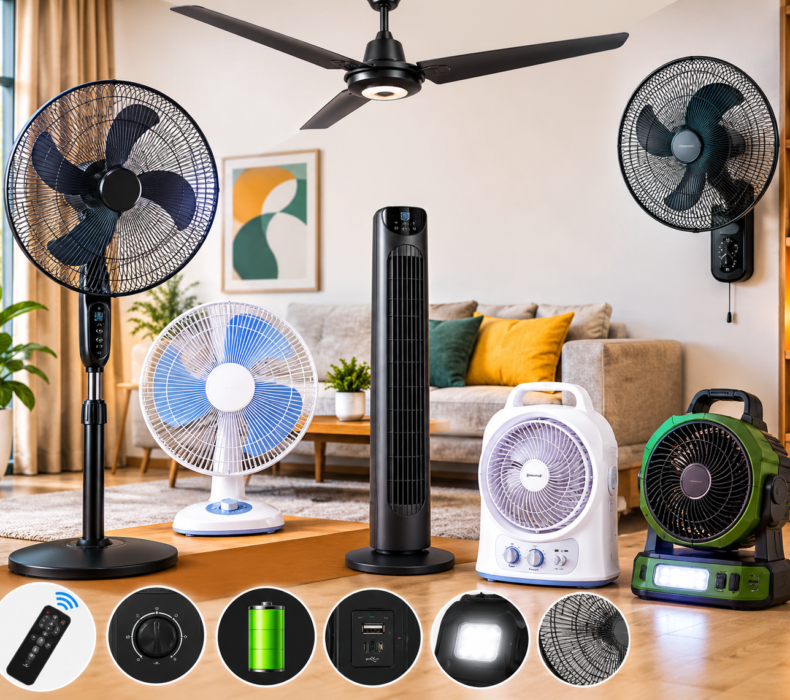
Electric Fans in Nigeria are popular cooling appliances for homes, offices, shops, schools, churches, and other indoor spaces. Because Nigeria experiences hot weather for much of the year, having a reliable fan can make a room more comfortable. Unlike air conditioners, electric fans are generally easier to install, consume less electricity, and are available at different prices.
Today, buyers can choose from standing fans, table fans, wall-mounted fans, ceiling fans, rechargeable fans, and other modern designs. Each type has its own benefits, so the right choice depends on your room size, budget, power supply, and cooling needs.
Moreover, modern fans now offer more than simple blade rotation. Some models have remote controls, multiple speed settings, oscillation, timers, rechargeable batteries, LED lights, sleep modes, and energy-saving motors. Therefore, understanding these features can help you choose a fan that offers good value for money.
Why Are Electric Fans Important in Nigeria?
The hot climate makes fans useful throughout much of the year. A good fan helps move air around a room, making people feel cooler and more comfortable.
Unlike an air conditioner, a fan does not usually lower the actual temperature of the room. Instead, it improves air circulation and increases the evaporation of sweat from the skin. As a result, you can feel cooler without using as much electricity as an air conditioner.
Furthermore, fans are useful when electricity costs are a concern. A household that wants basic cooling without running an air conditioner for several hours may find an electric fan more economical.
Fans are also convenient because they are available in many sizes. A small table fan may be enough for a personal workspace, while a powerful standing or ceiling fan may be more suitable for a large living room.
Types of Electric Fans in Nigeria
Before buying, it is important to understand the major types of electric fans available in Nigeria. Although they all circulate air, their designs and applications are different.
1. Standing Fans
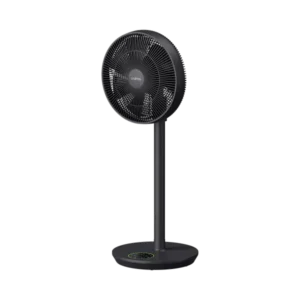
Standing fans are among the most common choices for Nigerian homes. They usually have a tall adjustable stand, a protective grille, rotating blades, and an oscillation function.
One major advantage is flexibility. You can move a standing fan from one room to another when necessary. Also, the height can often be adjusted to direct airflow toward different areas.
Standing fans are suitable for:
- Living rooms
- Bedrooms
- Offices
- Shops
- Classrooms
- Event spaces
Additionally, many models have three or more speed settings. Some advanced versions also include remote controls and timers.
2. Table Fans
Table fans are compact and designed to sit on desks, tables, shelves, or other stable surfaces. They are useful when cooling is needed in a specific area rather than throughout an entire room.
For example, a student can place a table fan on a study desk, while an office worker can use one near a computer workstation.
However, because of their smaller size, they may not move as much air as a large standing fan. Therefore, they are best for personal cooling and smaller spaces.
3. Wall-Mounted Fans
Wall-mounted fans are attached to a wall, which helps save floor and table space. They are particularly useful in crowded rooms, offices, shops, restaurants, classrooms, and workshops.
Since the fan is positioned above the floor, it can distribute air across a wider area. In addition, wall-mounted designs can be useful where children or pets could accidentally knock over a standing fan.
4. Ceiling Fans
Ceiling fans are installed permanently on the ceiling and circulate air across a large area. They are commonly used in living rooms, bedrooms, offices, restaurants, churches, schools, and commercial spaces.
A major benefit is that ceiling fans do not take up floor space. They can also provide broad airflow when correctly installed.
However, installation is more complicated than simply plugging in a standing or table fan. Therefore, professional installation is recommended, particularly for larger or heavier models.
5. Rechargeable Fans
Rechargeable fans have built-in batteries that allow them to operate without being connected continuously to mains electricity.
This makes them particularly useful in Nigeria, where power interruptions can affect homes and businesses. Depending on the model and battery capacity, a rechargeable fan may continue operating for several hours after being fully charged.
Some rechargeable models also include:
- LED emergency lights
- USB charging ports
- Multiple speed levels
- Remote controls
- Solar charging compatibility
- Battery indicators
Consequently, rechargeable fans can provide both cooling and emergency lighting during power outages.
6. Industrial Fans
Industrial fans are designed for larger spaces and demanding environments. They may be used in warehouses, factories, workshops, restaurants, garages, event centres, and commercial buildings.
These fans usually have powerful motors and larger blades. However, they may be noisier and consume more electricity than smaller household fans.
Important Features to Look for in Electric Fans
Choosing a fan based only on price can lead to disappointment. Instead, consider the features that affect performance, convenience, durability, and energy use.
Motor Quality
The motor is one of the most important parts of a fan. A reliable motor should provide consistent performance without overheating quickly.
Therefore, buyers should pay attention to motor quality and the reputation of the manufacturer. A cheaper fan may not always be the better bargain if it requires frequent repairs or replacement.
Speed Settings
Most electric fans have multiple speed settings. These allow you to adjust airflow depending on the weather and your comfort level.
For example, a low setting may be suitable at night, while a higher setting can provide stronger airflow during particularly hot afternoons.
Oscillation
Oscillation allows the fan to move from side to side while operating. This helps distribute air across a wider area.
For a family living room, an oscillating fan may therefore be more useful than a fan that directs air in only one direction.
Adjustable Height
Adjustable height is particularly useful for standing fans. You can position the airflow toward a sofa, bed, table, or other location.
Consequently, adjustable models provide greater flexibility than fixed-height designs.
Remote Control
A remote control can make a fan more convenient. Instead of getting up to change the speed or turn off the fan, you can operate it from a distance.
This feature is especially useful in bedrooms at night.
Timer Function
A timer allows the fan to switch off automatically after a selected period. This can be useful when sleeping or when you want to avoid leaving the fan running unnecessarily.
Additionally, timer functionality may help reduce electricity consumption.
Sleep Mode
Some modern fans include a sleep mode that gradually changes airflow or operates at a quieter speed.
This can be useful for people who prefer gentle airflow while sleeping.
Rechargeable Battery
If your area experiences frequent power interruptions, a rechargeable battery can be extremely useful.
However, do not focus only on battery capacity. Also consider charging time, battery type, expected runtime, replacement cost, and whether replacement batteries are available.
Noise Level
A noisy fan can become uncomfortable, particularly in bedrooms, offices, libraries, and study areas.
Therefore, buyers should consider models advertised as quiet or low-noise if noise is an important concern.
Blade Size
Blade size affects airflow and the area the fan can effectively cover. Larger blades can move a greater volume of air when combined with a suitable motor.
However, bigger does not automatically mean better. The fan should match the size and purpose of the room.
Electric Fan Prices in Nigeria
The price of electric fans in Nigeria varies considerably. This is because fan prices depend on the type, brand, size, motor quality, features, battery capacity, design, and place of purchase.
As a general guide, buyers may encounter the following broad price categories:
Basic table fans: approximately ₦15,000–₦35,000
Standard standing fans: approximately ₦25,000–₦70,000
Wall-mounted fans: approximately ₦25,000–₦65,000
Rechargeable fans: approximately ₦25,000–₦100,000+
Premium standing fans: approximately ₦60,000–₦150,000+
Ceiling fans: approximately ₦40,000–₦200,000+
Industrial fans: approximately ₦80,000–₦300,000+
These figures are only indicative because prices can change with exchange rates, promotions, availability, model specifications, and retailer pricing.
Therefore, it is advisable to compare prices from several sellers before making a purchase. Also, check whether the quoted price includes accessories, installation, delivery, warranty, or other additional costs.
What Determines the Price of an Electric Fan?
Several factors influence how much an electric fan costs in Nigeria.
Brand
Well-known brands may charge more because of their reputation, product support, warranty, and availability of spare parts.
However, brand name alone should not determine your decision. Compare the actual specifications and warranty before paying.
Fan Type
A basic table fan will normally cost less than a large rechargeable fan or premium ceiling fan. Similarly, industrial fans generally cost more because they are designed for demanding environments.
Motor Technology
Fans with efficient or advanced motor technology can cost more initially. However, they may provide better performance and potentially lower electricity consumption over time.
Battery Capacity
Rechargeable fans with larger batteries generally cost more. However, they may also provide longer operation during power outages.
Extra Features
Remote controls, timers, LED lights, USB charging ports, multiple speed settings, digital displays, and other features can increase the price.
How to Choose the Best Electric Fan for Your Home
There is no single fan that is perfect for everyone. Instead, the best choice depends on your specific needs.
Consider Your Room Size
Start by considering the size of the room.
A small bedroom or study area may only require a table fan. On the other hand, a large living room may benefit from a standing, ceiling, or powerful wall-mounted fan.
Consider Your Power Supply
Your electricity situation is another important factor.
If you have relatively stable electricity, a standard electric fan may be sufficient. However, if power outages are frequent, consider a rechargeable model.
Furthermore, rechargeable fans can be paired with suitable backup power systems for longer use during outages.
Consider Your Budget
Set a realistic budget before shopping. However, avoid choosing the cheapest fan simply because it costs less.
A fan that has a stronger motor, better construction, warranty, and available spare parts may offer better long-term value.
Consider Energy Consumption
Electricity efficiency matters, particularly for people who use fans for many hours each day.
Check the fan’s power rating and compare models before buying. In addition, efficient operation can help reduce running costs over time.
Check the Warranty
A warranty provides additional protection if the fan develops certain manufacturing problems within the stated period.
Before purchasing, ask about the warranty duration and what it covers. Also, confirm where repairs can be handled.
Check Spare Parts Availability
This is an important consideration that is sometimes overlooked.
Fan blades, capacitors, switches, remote controls, batteries, and other components may eventually need replacement. Therefore, choosing a model with readily available spare parts can make maintenance easier.
Electric Fans vs Air Conditioners
Electric fans and air conditioners serve different purposes.
An air conditioner actively cools the air, while a fan mainly improves air movement. As a result, air conditioners usually provide stronger cooling but also consume more electricity.
Fans are often cheaper to purchase and install. They also require less complicated maintenance.
However, an air conditioner may be preferable when precise temperature control is needed.
In many Nigerian homes, the two appliances can also work together. For example, using a fan alongside an air conditioner may help distribute cool air around a room more effectively. Nevertheless, the exact energy savings will depend on the equipment and how it is used.
How to Maintain an Electric Fan
Proper maintenance can improve performance and extend the life of your fan.
Clean the Blades Regularly
Dust can accumulate on fan blades and the protective grille. Over time, heavy dust buildup can affect airflow.
Therefore, switch off and unplug the fan before cleaning it. Remove the grille where possible and clean the blades carefully.
Keep the Motor Area Clean
Dust can also accumulate around the motor housing. Follow the manufacturer’s cleaning instructions to avoid damaging electrical components.
Check for Unusual Noise
If a fan suddenly becomes noisy, vibrating, or unstable, do not ignore the problem.
The issue could involve loose parts, worn bearings, an unbalanced blade, or another mechanical problem. Addressing the issue early may prevent more serious damage.
Avoid Overloading Rechargeable Fans
Rechargeable models should be charged according to the manufacturer’s instructions.
Avoid using unsuitable chargers because they can damage the battery or charging system.
Store Portable Fans Properly
If you are not using a portable or rechargeable fan for an extended period, keep it in a dry and clean location.
Also, follow the manufacturer’s recommendations for battery storage.
Safety Tips When Using Electric Fans
Safety should always come first when operating electrical appliances.
Keep the fan away from water and wet surfaces. Also, do not insert fingers or objects through the protective grille while the blades are moving.
For standing fans, place the appliance on a stable and level surface. Avoid positioning it where people can easily trip over the power cable.
Furthermore, do not use damaged cables, plugs, or extension cords. If you notice burning smells, sparks, unusual overheating, or repeated electrical faults, stop using the fan and have it checked by a qualified technician.
For ceiling fans, installation should be handled properly to ensure the fan is securely attached to the ceiling.
Common Mistakes to Avoid When Buying Electric Fans in Nigeria
Many buyers make decisions based mainly on appearance or price. However, this approach can result in poor value.
One common mistake is buying a fan that is too small for the room. Another is ignoring power consumption.
Some buyers also overlook warranty coverage and spare-part availability. Others purchase rechargeable fans without checking battery capacity or expected runtime.
Additionally, buying from an unreliable seller can create problems if the product is defective.
Therefore, compare specifications, prices, warranty terms, seller reputation, and customer reviews before making your final decision.
Where to Buy Electric Fans in Nigeria
Electric fans are available from appliance stores, electronics retailers, supermarkets, online marketplaces, and authorized distributors across Nigeria.
When buying online, check the seller’s reviews and product details carefully. Also, confirm whether the product is new, used, refurbished, or imported.
For physical stores, inspect the fan before paying when possible. Check the blades, grille, switches, stand, power cable, remote control, and other accessories.
Most importantly, request a receipt and warranty documentation where applicable.
check jumia.com
Frequently Asked Questions About Electric Fans in Nigeria
What is the best type of electric fan for a Nigerian home?
The best type depends on your room size, budget, electricity supply, and cooling needs. Standing fans are versatile, while rechargeable fans are useful where power outages are common.
How much does an electric fan cost in Nigeria?
Electric fan prices vary by type and features. Basic models can start around ₦15,000, while premium rechargeable, ceiling, and industrial models can cost considerably more.
Which fan is best during power outages?
A rechargeable fan is generally the most convenient option because its built-in battery allows it to continue operating when mains electricity is unavailable.
Do electric fans consume a lot of electricity?
Most household fans consume considerably less electricity than air conditioners. However, consumption depends on the fan’s wattage, speed, and operating hours.
How long can a rechargeable fan last?
Runtime varies according to battery capacity, fan speed, motor design, and other features. Always check the manufacturer’s stated runtime and test conditions before buying.
Are standing fans better than table fans?
Neither is universally better. Standing fans are usually more flexible and can cover a larger area, while table fans are compact and convenient for personal cooling.
Can a fan cool an entire room?
A fan can improve air circulation throughout a room, but it does not cool the air in the same way an air conditioner does. Its effectiveness depends on room size, fan capacity, placement, and ventilation.
Conclusion
Choosing among the many Electric Fans in Nigeria becomes easier when you focus on your actual needs rather than buying based only on appearance or price.
First, determine the size of the space you want to cool. Next, consider whether you need a standing, table, wall-mounted, ceiling, rechargeable, or industrial fan. After that, compare motor quality, speed settings, oscillation, noise level, power consumption, battery capacity, warranty, and spare-part availability.
Most importantly, think about your electricity supply. If power outages are common in your area, a rechargeable fan may offer greater convenience. On the other hand, a standard standing or table fan may be enough when you have reliable electricity.
Finally, compare prices from trusted sellers before making your purchase. A slightly more expensive fan with better construction, efficient performance, warranty support, and available replacement parts may provide greater value over time.




 Get it on
  Download on the