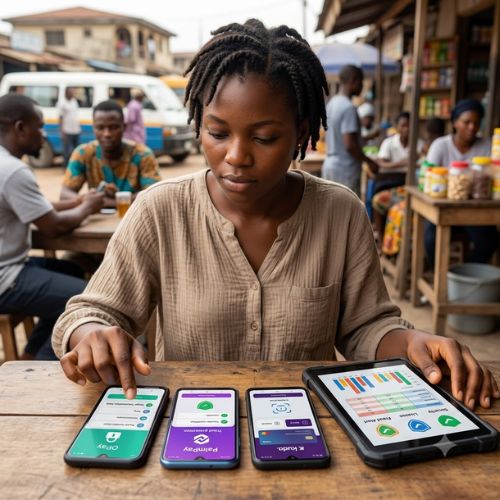
The digital financial ecosystem in West Africa is expanding at a remarkable pace. Today, traditional long banking queues are fast becoming obsolete as smartphones handle the heavy lifting of modern commerce. Consequently, millions of market vendors, corporate workers, and students rely heavily on fintech infrastructure to execute swift peer-to-peer retail transactions. This reliance makes choosing between OPay vs. PalmPay vs. Kudaa vital security priority.
While these institutions promise instant delivery speeds, security risks like phishing scams and unauthorized access require close evaluation. Therefore, choosing the right platform demands analyzing data encryption, fraud protection, and regulatory licensing. This comprehensive review examines the safety protocols of these three primary financial apps to help you protect your daily funds.
The Regulatory Framework: Licensing and Insurance
Before evaluating app safety features, you must confirm their official operational legitimacy within the Nigerian financial space:
The Central Bank Base: The Central Bank of Nigeria (CBN) strictly monitors and licenses all three platforms to ensure complete operational compliance.
Deposit Insurance Safety: The Nigeria Deposit Insurance Corporation (NDIC) officially insures your personal account balance up to ₦5,000,000 across these institutions. Consequently, your funds remain secure even during rare institutional structural liquidations.
Regulatory Oversight: These digital portals comply fully with the Nigeria Data Protection Regulation (NDPR) to prevent corporate leaks of private user records.
Deep-Dive Security Profiles of the Apps
1. OPay Digital Services
OPay functions as a massive financial powerhouse, commanding a huge share of daily retail payments across Nigerian commercial hubs.
Advanced Protection Tools: The application provides unique, proactive security layers like the NightGuard feature.When you activate NightGuard, the app automatically blocks all late-night transfers between 11:00 PM and 7:00 AM unless you pass live facial verification tests.
Transaction Safeguards: OPay features a Large Transaction Shield.This tool enables you to set personal transfer limits from ₦100,000 to ₦600,000, which completely locks down unauthorized bulk withdrawals.
The Safety Trade-Off: The platform is highly target-heavy for sophisticated phishing networks. Scammers frequently use spoofed SMS alerts and fake customer support calls to trick careless users.
2. PalmPay Nigeria
PalmPay positions itself as an ultra-fast, reward-driven financial wallet designed for swift consumer payments and micro-merchant operations.
Advanced Protection Tools: The app uses real-time proprietary screening systems to analyze transfer patterns and instantly intercept suspicious activity.It holds full PCI DSS security certifications to defend transaction pathways against digital data theft.
Transaction Safeguards: It utilizes encrypted data channels and provides prompt push notifications to track every single kobo that enters or leaves your account.
The Safety Trade-Off: If an unexpected failed transaction occurs, users sometimes experience customer support response delays while trying to resolve the dispute.
3. Kuda Microfinance Bank
Kuda Bank operates as a full-fledged digital microfinance bank, earning the reputation of “the bank of the free” among tech-savvy youth.
Advanced Protection Tools: Kuda utilizes strict, mandatory Bank Verification Number (BVN) and National Identification Number (NIN) verification checks during onboarding.It fully integrates biometrics, 3D Secure verification codes, and dynamic web cards.
Transaction Safeguards: The app allows you to customize card control settings.You can instantly block or unblock POS, ATM, or web payment channels with a single tap.
The Safety Trade-Off: Because it functions like a traditional structured bank, it enforces strict anti-fraud compliance rules. This means accounts can face sudden temporary limitations during routine security audits.
Direct Security Features Comparison Matrix
To settle the debate of OPay vs. PalmPay vs. Kuda, evaluate this comprehensive safety grid:
Evaluation Criteria
OPay Digital Services
PalmPay Nigeria
Kuda Microfinance Bank
CBN License Status
Mobile Money Operator
Mobile Money Operator
Microfinance Bank License
Biometric Security
Facial and Fingerprint ID
Fingerprint Lock System
Face ID and Fingerprint
Specialized Protection
NightGuard & Large Shield
Automated Fraud Interception
Custom Card Control Toggles
NDIC Insurance Max
₦5,000,000 protected
₦5,000,000 protected
₦5,000,000 protected
Support Resolution
In-App Live Chat Agents
Chat, Social Media, Email
Direct In-App Chat Support
Essential Safety Tactics for Daily Transfers
Regardless of your preferred application, you must practice disciplined financial safety habits to protect your hard-earned money:
Enable Multi-Factor Biometrics: Always activate face or fingerprint authentication for logging in and authorizing transfers. Never rely solely on easy-to-guess 4-digit PIN codes.
Treat Otps as Confidential: No legitimate customer agent from OPay, PalmPay, or Kuda will ever ask for your One-Time Password (OTP) or transaction PIN via a phone call.
Audit Your Card Settings: If you own a digital or physical debit card, use your app settings to toggle web transactions off when they are not in active use.
Final Strategic Verdict
Ultimately, all three applications provide exceptional, bank-grade encryption to protect your daily transfers. However, they excel in slightly different security niches:
Choose OPay if you routinely handle larger transaction volumes and want specialized tools like NightGuard to secure your funds during late-night hours.
Choose PalmPay if you want a lightweight, fast, and reward-driven wallet for small everyday transactions like airtime and utility bills.
Choose Kuda Bank if you prefer a highly structured digital banking environment with robust card management controls and strict identity verification protocols.














 Get it on
  Download on the