When comparing Inverter Air Conditioner vs Non-Inverter Air Conditioner, many homeowners want to know which option offers better cooling, lower electricity bills, and greater long-term value. While both types of air conditioners are designed to keep your home comfortable, they operate differently and have unique advantages. Understanding these differences will help you choose the right cooling solution for your home, office, or business in Nigeria.
What Is an Inverter Air Conditioner?
An inverter air conditioner uses advanced compressor technology that automatically adjusts its operating speed based on the room’s cooling needs.
Instead of constantly turning the compressor on and off, the inverter compressor runs continuously at varying speeds. Consequently, it maintains a stable temperature while using less electricity.
Because the compressor does not restart frequently, inverter air conditioners provide smoother and more efficient cooling.
What Is a Non-Inverter Air Conditioner?
A non-inverter air conditioner uses a traditional compressor that works at one fixed speed.
Once the desired room temperature is reached, the compressor shuts off completely. When the room becomes warmer again, the compressor starts again at full power.
Although this system cools effectively, the repeated starting and stopping consumes more electricity and causes greater wear on the compressor over time.
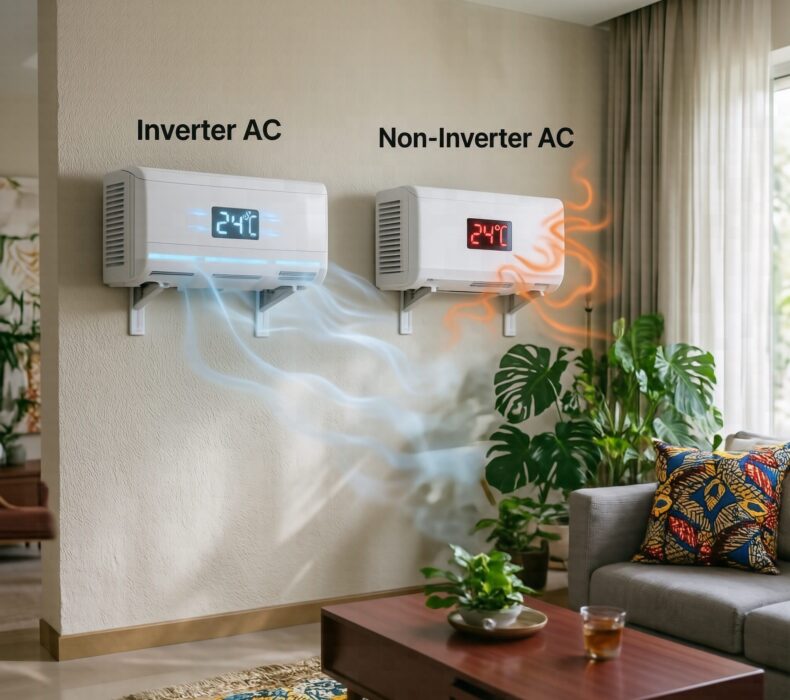
An inverter model continuously adjusts its cooling output according to the room temperature. In contrast, a non-inverter model repeatedly switches the compressor on and off.
As a result, inverter air conditioners provide more consistent temperatures, while non-inverter units often experience slight temperature fluctuations.
Energy Efficiency
One of the main reasons homeowners choose inverter technology is energy savings.
An inverter air conditioner:
Consumes less electricity
Adjusts power based on cooling demand
Reduces unnecessary compressor operation
Lowers monthly energy bills
On the other hand, non-inverter air conditioners consume more electricity because the compressor restarts frequently at maximum power.
Therefore, if reducing electricity costs is your priority, inverter technology is the better option.
Cooling Performance
Both air conditioner types can cool a room effectively. However, they deliver cooling differently.
Inverter air conditioners:
Cool rooms faster
Maintain consistent temperatures
Prevent sudden temperature changes
Operate smoothly
Meanwhile, non-inverter air conditioners:
Cool efficiently
Stop cooling after reaching the set temperature
Restart once the room becomes warmer
Consequently, inverter models usually provide a more comfortable indoor environment.
Electricity Consumption
Electricity costs are an important consideration for Nigerian households.
Although inverter air conditioners may run continuously, they operate at lower speeds after reaching the desired temperature. As a result, they consume considerably less electricity over time.
In comparison, non-inverter models repeatedly use maximum power whenever the compressor restarts.
For families that use air conditioners for several hours daily, inverter models often lead to noticeable savings on electricity bills.
Noise Levels
Quiet operation is another major advantage of inverter technology.
Since the compressor changes speed gradually, inverter air conditioners produce less noise during operation.
Conversely, non-inverter units may become louder whenever the compressor switches on.
For bedrooms, nurseries, libraries, and offices, quieter operation makes inverter air conditioners a preferred choice.
Lifespan and Durability
The compressor is the most important component of any air conditioner.
Because inverter compressors avoid constant stopping and starting, they generally experience less mechanical stress.
This leads to:
Longer compressor life
Fewer breakdowns
Lower maintenance costs
Improved reliability
While non-inverter units are still durable, their compressors usually experience greater wear over time due to repeated power cycling.
Purchase Price
One area where non-inverter air conditioners have an advantage is the initial purchase cost.
Generally:
Non-inverter models cost less to buy.
Inverter models require a higher upfront investment.
However, the lower electricity bills of inverter units often offset the higher purchase price after a few years of regular use.
Therefore, it is important to consider the total cost of ownership rather than only the purchase price.
Performance During Power Supply Changes
Nigeria experiences frequent power interruptions and voltage fluctuations.
Fortunately, many inverter air conditioners are designed with advanced electronics that help them operate more efficiently under varying power conditions when paired with appropriate voltage protection.
Additionally, because inverter models consume less electricity, they perform better with:
Solar systems
Home inverter systems
Backup batteries
Energy-efficient generators
This makes them an excellent choice for homes seeking lower energy consumption.
Maintenance Requirements
Both types of air conditioners require regular maintenance.
To ensure optimal performance:
Clean the air filters regularly.
Service the unit every few months.
Keep the outdoor unit free from dirt.
Inspect refrigerant levels when necessary.
Protect the system with a quality voltage stabilizer.
Proper maintenance extends the lifespan of both inverter and non-inverter air conditioners.
Which One Is Better for Nigerian Homes?
The answer depends on your budget and cooling needs.
Choose an inverter air conditioner if you:
Use your air conditioner every day.
Want lower electricity bills.
Need quieter operation.
Prefer long-term savings.
Use solar or inverter backup systems.
Choose a non-inverter air conditioner if you:
Have a limited budget.
Use your air conditioner occasionally.
Need a simple cooling solution.
Want a lower initial purchase price.
For most families, however, inverter technology offers better long-term value.
Tips for Choosing the Right Air Conditioner
When comparing Inverter Air Conditioner vs Non-Inverter Air Conditioner, also consider these important factors:
Room Size
Select a cooling capacity that matches your room dimensions.
Energy Rating
Choose energy-efficient models to reduce electricity consumption.
Trusted Brand
Purchase from reputable manufacturers with reliable after-sales support.
Installation
Professional installation ensures better cooling and longer equipment life.
Warranty
A good warranty provides additional peace of mind and protects your investment.
Conclusion
The debate over Inverter Air Conditioner vs Non-Inverter Air Conditioner ultimately comes down to balancing your budget with long-term operating costs. While non-inverter models are generally more affordable upfront, inverter air conditioners deliver better energy efficiency, quieter performance, faster cooling, and greater long-term savings.










 Get it on
  Download on the