Knowing How to Choose the Right Fan for Your Homecan help you stay comfortable while avoiding unnecessary spending. Fans are useful cooling appliances for bedrooms, living rooms, kitchens, offices, and other spaces. In Nigeria, where hot weather can make indoor spaces uncomfortable, a reliable fan can provide much-needed airflow throughout the day.
However, choosing a fan is not simply about buying the biggest or most powerful model. Different rooms have different cooling requirements. For instance, a small bedroom may need a compact table fan, while a large living room may benefit from a powerful standing or ceiling fan.
Furthermore, your electricity supply, room size, budget, noise preference, and desired features should all influence your decision. Rechargeable fans can also be useful in areas where power interruptions are common.
Therefore, before buying a fan, it is important to understand the different types available and the features that affect performance.
Why Choosing the Right Fan Matters
A fan is an appliance you may use for several hours every day. Consequently, choosing the right model can affect your comfort, electricity costs, convenience, and long-term satisfaction.
A suitable fan should provide enough airflow without being unnecessarily large or expensive. It should also fit comfortably within your available space.
Moreover, the right fan can help improve air circulation without requiring the higher energy consumption associated with many air-conditioning systems.
For example, a small fan may be enough for personal cooling at a desk. On the other hand, a larger room may require a fan with wider airflow coverage.
Ultimately, the best fan is the one that matches your room, lifestyle, electricity situation, and budget.
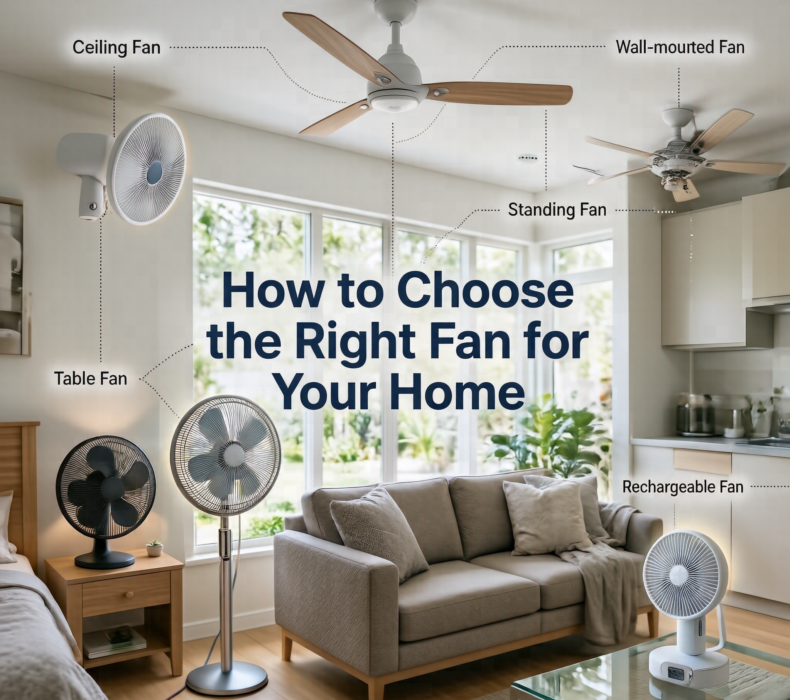
Standing fans, also called pedestal fans, are among the most flexible options for homes.
They usually have an adjustable stand, multiple speed settings, oscillation, and a protective grille. Some modern models also include remote controls and timers.
One major advantage is portability. You can move a standing fan from the bedroom to the living room whenever necessary.
Standing fans are suitable for:
Living rooms
Bedrooms
Dining areas
Offices
Shops
Larger indoor spaces
They are particularly useful if you want strong airflow without installing anything permanently.
Ceiling Fans
Ceiling fans are installed permanently on the ceiling and distribute air over a wide area.
They are suitable for large living rooms, bedrooms, dining areas, offices, restaurants, schools, and other spacious areas.
Because they do not occupy floor space, ceiling fans can also help keep rooms less cluttered.
However, installation requires more work than using a standing fan. Therefore, professional installation is recommended.
Table Fans
Table fans are compact and designed for smaller spaces.
You can place them on a desk, table, shelf, bedside table, or other stable surface. They are particularly useful when you want airflow directed toward one person.
For example, a student studying at a desk may find a table fan more practical than a large standing fan.
However, their airflow coverage is usually more limited than that of larger fans.
Wall-Mounted Fans
Wall-mounted fans are attached to a wall rather than placed on the floor.
This makes them useful in rooms where floor space is limited. They can also provide airflow from an elevated position.
Wall fans are commonly used in:
Kitchens
Offices
Shops
Restaurants
Classrooms
Workshops
Bedrooms
Additionally, mounting the fan on the wall can reduce the risk of accidentally knocking it over.
Rechargeable Fans
Rechargeable fans have built-in batteries that allow them to operate without continuous connection to mains electricity.
This makes them particularly useful in Nigeria, especially where power interruptions occur.
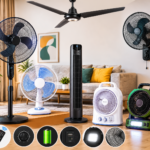
Depending on the model, a rechargeable fan may include:
LED lighting
USB charging
Remote control
Multiple speed settings
Battery indicators
Timer functions
Solar charging support
However, battery capacity and runtime vary considerably. Therefore, check the specifications before purchasing.
Tower Fans
Tower fans have a tall, slim design and are often chosen for modern interiors.
They occupy relatively little floor space and can fit easily into corners. Some models also include remote controls, timers, sleep modes, and digital displays.
They can be suitable for bedrooms, living rooms, and offices where appearance and space-saving design are important.
Consider the Size of Your Room
Room size is one of the most important factors when choosing a fan.
A small fan may provide enough airflow in a small bedroom. However, it may struggle to circulate air effectively in a large living room.
Similarly, purchasing an extremely powerful fan for a tiny room may be unnecessary.
Therefore, consider the size of the space before choosing the fan.
Small Rooms
For bedrooms, study rooms, and small offices, consider:
Table fans
Small standing fans
Compact rechargeable fans
Small wall-mounted fans
These options can provide sufficient airflow without taking up too much space.
Medium-Sized Rooms
For medium-sized bedrooms and living rooms, consider:
Standing fans
Wall-mounted fans
Larger table fans
Medium-sized ceiling fans
A fan with oscillation can be particularly useful because it distributes air across a wider area.
Large Rooms
For large living rooms, open-plan spaces, halls, and commercial areas, consider:
Large standing fans
Ceiling fans
Powerful wall-mounted fans
Industrial fans where appropriate
In large spaces, airflow coverage is more important than simply choosing a fan based on appearance.
Check the Fan’s Airflow
Airflow determines how effectively a fan can circulate air.
A fan with strong airflow can make a room feel more comfortable, especially during hot weather.
However, stronger airflow is not always necessary. If you are buying a fan for a bedroom, extremely powerful airflow may be uncomfortable while sleeping.
Therefore, look for a model with adjustable speed settings.
This allows you to select gentle airflow at night and stronger airflow during hot afternoons.
Look at the Blade Size
Blade size can influence the amount of air a fan moves.
Larger blades can generally move more air when paired with an appropriate motor. However, blade size should match the fan design and room.
For example, a compact table fan may have smaller blades because it is designed for personal cooling.
Meanwhile, larger standing and ceiling fans may use larger blades to distribute air over a wider area.
Therefore, do not choose a fan based only on blade size. Consider the motor, fan design, speed settings, and room size together.
Consider the Motor Quality
The motor is one of the most important components of an electric fan.
A good motor should provide reliable operation without excessive overheating or unusual noise under normal conditions.
When comparing models, check the manufacturer’s specifications and warranty.
Furthermore, consider how long you expect to operate the fan each day. If the fan will run for many hours, motor quality becomes even more important.
A slightly more expensive model with better construction may provide better long-term value than a very cheap fan that requires frequent repairs.
Check the Number of Speed Settings
Different weather conditions require different airflow levels.
Therefore, a fan with multiple speed settings provides greater flexibility.
For example:
Low speed: Suitable for sleeping or mild weather.
Medium speed: Useful for everyday cooling.
High speed: Suitable for very hot afternoons or rooms requiring stronger airflow.
Some modern fans offer additional modes such as natural wind or sleep mode.
These features can improve comfort because you can adjust the fan according to your needs.
Consider Oscillation
Oscillation allows the fan to move from side to side.
This feature is useful because it spreads airflow across a wider part of the room.
For a family living room, an oscillating standing fan may be more useful than a fixed fan pointing in one direction.
Similarly, a wall-mounted fan with a wide oscillation angle can improve air circulation in an office or shop.
Therefore, check both the oscillation function and the range of movement before buying.
Think About Noise Level
Noise is another important factor, especially in bedrooms.
A fan that is too noisy can interfere with sleep, studying, reading, or working.
Consequently, if you are buying a fan for a bedroom or office, look for a model designed for quiet operation.
Also, remember that a fan can become noisier over time if dust accumulates or components become loose.
Regular cleaning and maintenance can therefore help maintain quieter operation.
Consider Your Electricity Supply
Electricity supply should play an important role in your decision.
If your home has reliable electricity, a conventional electric fan may be perfectly suitable.
However, if you experience frequent power outages, a rechargeable fan can provide greater convenience.
Rechargeable fans continue operating using their built-in batteries after mains electricity goes off.
Furthermore, some models provide emergency LED lights and USB charging, making them useful during outages.
However, check the battery capacity carefully. A fan with a larger battery may offer longer runtime, but charging time and battery quality also matter.
Compare Energy Consumption
Fans generally use less electricity than air conditioners. Nevertheless, energy consumption varies between fan models.
Before purchasing, check the fan’s wattage.
A fan with a lower power rating may consume less electricity during operation. However, wattage should not be considered alone.
Motor efficiency, operating speed, fan size, and daily usage all affect your electricity consumption.
For example, running a fan at high speed for 12 hours every day will generally consume more electricity than using the same fan at a lower speed for a few hours.
Therefore, choose a model that provides sufficient airflow without unnecessary power consumption.
Consider a Remote Control
A remote control can make a fan much easier to use.
Instead of getting up to change the speed, switch the fan off, or activate a timer, you can control it from a distance.
This is particularly convenient in bedrooms.
Moreover, some modern fans allow you to control several functions through a remote, including speed, oscillation, mode, and timer settings.
However, remember that a remote control also introduces another component that can eventually require replacement.
Check for a Timer Function
A timer allows the fan to switch off automatically after a set period.
This feature is useful when sleeping because you can set the fan to operate for a specific amount of time.
It can also help prevent the fan from running unnecessarily when nobody is using the room.
Therefore, if you regularly forget to switch off appliances, a timer may be a worthwhile feature.
Consider Sleep Mode
Some modern fans include a sleep mode designed for nighttime use.
Depending on the model, sleep mode may reduce the fan speed or adjust airflow automatically.
This can create a more comfortable environment while reducing unnecessary noise.
However, not every fan has this feature, so check the specifications if it is important to you.
Check the Fan’s Build Quality
A fan should be strong enough to withstand regular use.
Before buying, examine the:
Fan grille
Blades
Stand
Base
Motor housing
Power cable
Switches
Control panel
For a standing fan, the base should be stable. It should not wobble easily when the fan is operating.
Similarly, the protective grille should be properly secured.
Good build quality can improve durability and safety.
Consider Safety Features
Safety is particularly important when buying a fan for a family home.
The fan should have a protective grille that prevents easy contact with the moving blades.
For standing fans, the base should be stable and strong.
Additionally, keep electrical cables away from areas where people can trip over them.
Do not operate a fan near water unless the product is specifically designed for that environment.
If you notice exposed wires, burning smells, sparks, or unusual overheating, stop using the fan and have it inspected by a qualified technician.
Think About the Fan’s Placement
Where you intend to place the fan can determine which type you should buy.
For example, if your floor space is limited, a wall-mounted fan may be better.
If you have a desk, a table fan may be sufficient.
If you want airflow across a large room without taking up floor space, a ceiling fan may be ideal.
Meanwhile, a standing fan offers the most flexibility because you can move it when needed.
Therefore, think about the location before buying.
Choose a Fan That Matches Your Lifestyle
Your daily routine should also influence your decision.
If you spend most of the day working at a desk, a table fan may be enough.
If you frequently move between rooms, a standing fan provides greater flexibility.
If you experience frequent power outages, choose a rechargeable model.
On the other hand, if you want a permanent cooling solution for a large living room, a ceiling fan may be more appropriate.
Consequently, the best fan is not necessarily the most expensive one. It is the model that fits your lifestyle.
Consider Your Budget
Price is naturally an important factor when buying a fan.
However, the cheapest fan is not always the best value.
Instead, compare the price with the features and expected lifespan.
For example, a slightly more expensive fan may include a stronger motor, better warranty, remote control, timer, or rechargeable battery.
Therefore, consider the total value rather than the initial price alone.
Check the Warranty
A warranty provides protection against certain manufacturing defects.
Before buying, check:
Warranty length
What the warranty covers
Where repairs are handled
Whether replacement parts are available
Whether the seller is authorized
A longer warranty can provide greater peace of mind, especially for a fan that will be used frequently.
Check Spare Parts Availability
Spare parts are often overlooked when buying electrical appliances.
However, components such as fan blades, capacitors, switches, remote controls, batteries, and power cables may eventually need replacement.
Therefore, consider choosing a brand with accessible spare parts and service support.
This is particularly important for rechargeable fans because batteries may eventually lose their ability to hold a charge.
How to Choose a Fan for a Bedroom
When selecting a bedroom fan, prioritize comfort and quiet operation.
Look for:
Low-noise performance
Multiple speed settings
Remote control
Timer
Oscillation
Adjustable airflow
Rechargeable battery if needed
A standing fan can be a good choice because you can position it beside the bed.
Alternatively, a ceiling fan can provide wider airflow without occupying floor space.
For people who experience regular power outages, a rechargeable fan may be especially useful.
How to Choose a Fan for a Living Room
Living rooms usually need broader airflow because several people may occupy the space.
A standing fan, ceiling fan, or wall-mounted fan can work well depending on the size and layout of the room.
For larger living rooms, consider a fan with strong airflow and a wide oscillation range.
Also, think about where people usually sit. The fan should be positioned so that air can circulate effectively without creating an uncomfortable direct blast.
How to Choose a Fan for a Kitchen
Kitchens can become hot because of cooking appliances.
A wall-mounted fan can be a practical option because it saves counter and floor space.
However, avoid placing a fan too close to open flames or areas where it could come into contact with water or cooking oil.
Additionally, clean kitchen fans regularly because grease and dust can accumulate more quickly.
How to Choose a Fan for an Office
For an office, noise and space are especially important.
A quiet table fan can be suitable for an individual workstation.
Alternatively, a wall-mounted or ceiling fan can cool a larger office without taking up desk space.
Remote control and multiple speed settings can also improve convenience.
How to Choose a Fan for a Child’s Room
Safety should be the priority when choosing a fan for a child’s room.
A fan should have a secure protective grille and stable construction.
Place standing fans where children cannot easily pull them over or interfere with the controls.
A properly installed ceiling fan can also reduce the risk of a child reaching the moving blades.
Furthermore, avoid leaving electrical cables where children can trip over them.
Electric Fan vs Air Conditioner
When deciding how to cool your home, you may wonder whether to choose a fan or air conditioner.
An air conditioner actively cools the air and allows you to control room temperature. However, it generally costs more to purchase, install, and operate.
A fan mainly circulates air. It does not reduce the actual room temperature in the same way an air conditioner does.
Nevertheless, fans are generally simpler and more affordable.
For many Nigerian homes, a fan can provide practical everyday cooling while consuming less electricity than an air conditioner.
Common Mistakes to Avoid When Buying a Fan
Choosing Only by Price
The cheapest fan may not provide the best value.
Always compare the motor, airflow, construction, warranty, and features.
Buying the Wrong Size
A fan that is too small may not cool a large room effectively.
Therefore, match the fan size to the room.
Ignoring Power Consumption
If you use your fan for many hours each day, electricity consumption matters.
Check the wattage and compare different models.
Ignoring Noise
A noisy fan can become frustrating in a bedroom or office.
Therefore, consider noise levels before purchasing.
Forgetting About Maintenance
Even a high-quality fan needs cleaning and proper care.
Dust buildup can affect airflow and performance.
Buying a Rechargeable Fan Without Checking Battery Capacity
The word “rechargeable” does not automatically mean long battery life.
Check the battery capacity, charging time, expected runtime, and replacement options.
How to Maintain Your Fan
Regular maintenance can help your fan operate efficiently for longer.
First, unplug the fan before cleaning it.
Next, clean the grille and blades regularly to remove dust.
For standing fans, check the base and stand to ensure they remain secure.
Also, inspect the power cable for damage.
If the fan begins making unusual sounds, vibrating excessively, or overheating, stop using it until the problem is checked.
For rechargeable models, use the recommended charger and follow the manufacturer’s battery-care instructions.
Conclusion
Learning How to Choose the Right Fan for Your Home becomes much easier when you focus on your actual cooling needs instead of buying based only on appearance or price.
First, consider the size of the room. Next, decide whether you need a standing, ceiling, table, wall-mounted, tower, or rechargeable fan. After that, compare airflow, blade size, motor quality, speed settings, oscillation, noise level, energy consumption, and additional features.
Furthermore, think about your electricity supply. If power outages are common, a rechargeable fan can provide valuable backup cooling. If electricity is stable, a conventional fan may be sufficient.
Finally, check the warranty, spare-part availability, build quality, and seller reputation before paying. A fan that costs slightly more but offers better durability and useful features may provide greater value over time.












 Get it on
  Download on the