If you have ever searched for skincare products to remove dead skin cells, unclog pores, or achieve smoother-looking skin, you have probably come across terms like face scrub, exfoliator, exfoliating cleanser, chemical exfoliant, and peeling solution. Although these terms are sometimes used interchangeably, they do not all mean exactly the same thing.
So, what is the difference between a face scrub vs exfoliator, and which one should you choose for your skin?
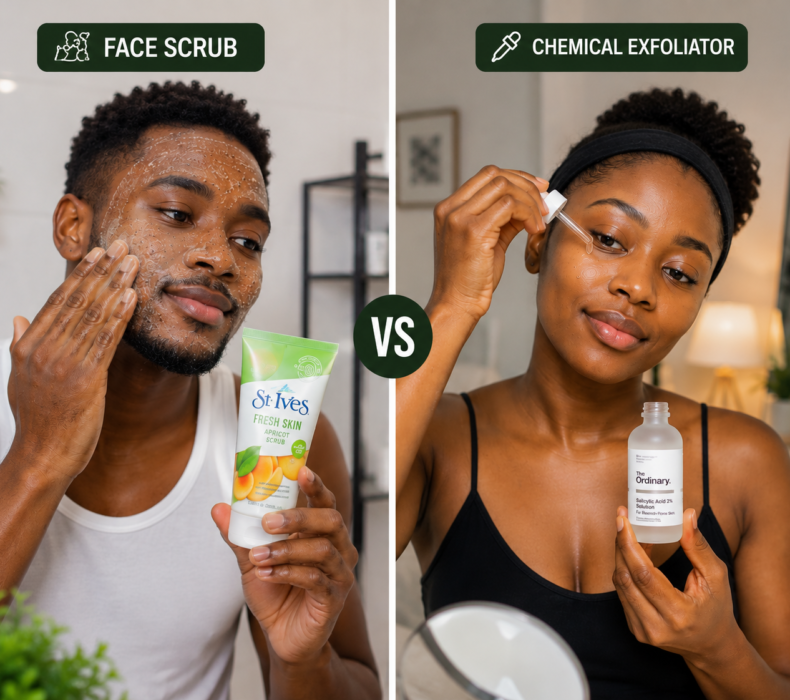
The simple answer is that a face scrub is one type of exfoliator, while “exfoliator” is a broader term that includes both physical and chemical products designed to remove or loosen dead skin cells.
Choosing the right exfoliation method depends on your skin type, concerns, sensitivity, and skincare routine. Using the wrong product or exfoliating too frequently can cause dryness, irritation, redness, or a damaged skin barrier.
In this guide, we will explain the difference between face scrubs and exfoliators, their benefits and disadvantages, how to use them, and which option may be better for different skin types.
What Is a Face Scrub?
A face scrub is a skincare product that physically exfoliates the surface of the skin. It usually contains small particles or granules that help loosen and remove dead skin cells when gently massaged over the skin.
Common physical exfoliating ingredients found in face scrubs include finely ground particles, silica, jojoba beads, rice powder, or other exfoliating materials.
Face scrubs are commonly marketed for concerns such as:
Rough skin
Dull complexion
Uneven skin texture
Clogged pores
Blackheads
Whiteheads
Excess surface oil
Buildup of dead skin cells
Unlike chemical exfoliators, which work through acids or enzymes, face scrubs rely primarily on gentle physical action.
Benefits of Face Scrubs
When used correctly, a face scrub can make the skin feel smoother and softer almost immediately.
Some potential benefits include:
1. Removes surface dead skin cells
Face scrubs help physically lift dead skin cells from the skin’s surface, leaving the complexion feeling smoother.
2. Improves skin texture
Regular but gentle exfoliation can help reduce the feeling of rough or uneven skin.
3. Helps remove buildup
A suitable scrub can help remove excess oil, dirt, and product buildup from the skin’s surface.
4. Creates a smoother appearance
Removing surface buildup can temporarily make the skin look brighter and more polished.
5. Can help skincare feel more effective
When excess dead skin cells are removed, skincare products can spread more easily across the skin.
However, more exfoliation is not necessarily better. Scrubbing aggressively or using a scrub too often can irritate the skin.
What Is an Exfoliator?
An exfoliator is a broader category of skincare products or ingredients designed to remove or loosen dead skin cells.
There are two major types of exfoliation:
1. Physical Exfoliation
Physical exfoliation uses friction or particles to remove dead skin cells.
Examples include:
Face scrubs
Exfoliating brushes
Washcloths
Exfoliating pads
Facial cleansing devices
A face scrub therefore falls under the category of physical exfoliators.
2. Chemical Exfoliation
Chemical exfoliators use ingredients that help loosen the bonds between dead skin cells so they can shed more easily.
Common chemical exfoliating ingredients include:
Salicylic acid
Glycolic acid
Lactic acid
Mandelic acid
Polyhydroxy acids (PHAs)
Chemical exfoliators are often available as toners, serums, masks, cleansers, or treatment products.
For example, salicylic acid is a beta hydroxy acid (BHA) that is particularly popular in products formulated for oily and blemish-prone skin.
Face Scrub vs Exfoliator: What Is the Difference?
The biggest difference is that a face scrub is a specific type of physical exfoliator, while exfoliator is a general term covering several exfoliation methods.
Feature
Face Scrub
Exfoliator
Meaning
A specific physical exfoliating product
Broad category of exfoliating products
Method
Usually physical
Physical or chemical
Common ingredients
Exfoliating particles
AHAs, BHAs, PHAs, enzymes or particles
Application
Usually massaged onto skin
Depends on product
Suitable for
Mainly surface exfoliation
Can target surface and pore-related concerns
Examples
Facial scrub
Scrub, salicylic acid serum, glycolic acid toner
Risk of irritation
Can increase with aggressive scrubbing
Depends on ingredient and concentration
Therefore, asking whether a face scrub or exfoliator is better is slightly misleading because a face scrub is already an exfoliator.
The more useful question is: Which type of exfoliation is best for your skin?
Face Scrub vs Chemical Exfoliator: Which Is Better?
Neither option is automatically better for everyone.
The right choice depends on your skin and what you want to achieve.
Face Scrub May Be Better If You Prefer Physical Exfoliation
A gentle face scrub may appeal to people who like the immediate smooth feeling that comes from physical exfoliation.
It may be useful for someone looking to improve the feel of rough, dull skin without introducing acids into their routine.
However, the scrub should be gentle. Avoid products with very harsh or sharp particles and avoid aggressively rubbing the skin.
Chemical Exfoliators May Be Better for Specific Skin Concerns
Chemical exfoliants can be useful when you want to target specific concerns beyond surface roughness.
For example:
Salicylic acid: Often used in skincare for oily and blemish-prone skin because it can penetrate into pores.
Glycolic acid: An AHA commonly used to improve the appearance of dullness and uneven skin texture.
Lactic acid: Generally considered a gentler AHA option and can be useful for people who want exfoliation while being mindful of dryness.
Mandelic acid: A larger-molecule AHA that is often chosen for gentler exfoliation.
PHAs: These are generally considered gentler exfoliating acids and may be suitable for some people with sensitive skin.
Which Is Better for Oily and Acne-Prone Skin?
If you have oily or acne-prone skin, choosing an exfoliating product requires care.
A salicylic acid exfoliator may be more useful than a traditional face scrub for some people because salicylic acid is oil-soluble and can work within pores.
This does not mean everyone with acne should use strong exfoliating acids. Acne can have many causes, and excessive exfoliation may worsen irritation.
If you have active, inflamed acne, avoid aggressively scrubbing the affected areas.
A gentle cleanser, appropriate acne treatment, moisturizer, and sunscreen are often more important foundations of an acne-care routine.
Which Is Better for Dry Skin?
People with dry skin need to be particularly careful with exfoliation.
A harsh face scrub may strip the skin and make dryness or irritation more noticeable.
If you have dry skin, consider a gentle exfoliating product used occasionally rather than aggressive physical scrubbing.
Look for products formulated with gentler exfoliating ingredients and combine exfoliation with a moisturizing skincare routine.
Which Is Better for Sensitive Skin?
Sensitive skin may react easily to aggressive physical exfoliation or strong chemical products.
If your skin is sensitive, avoid:
Hard scrubbing
Rough exfoliating particles
Very frequent exfoliation
Combining several exfoliating products
Using exfoliating acids without introducing them gradually
A gentle exfoliating product may be more appropriate, but always pay attention to how your skin responds.
If your skin becomes persistently red, painful, burning, or irritated, stop the exfoliating product and consider professional skincare advice.
Can You Use a Face Scrub and Chemical Exfoliator Together?
For most people, using multiple exfoliating products at the same time is unnecessary.
For example, using a face scrub followed by a strong glycolic acid product can provide more exfoliation than your skin needs.
Combining exfoliating ingredients can increase the possibility of:
Dryness
Burning
Redness
Flaking
Increased sensitivity
Skin barrier irritation
Instead of trying to exfoliate as much as possible, focus on consistent and gentle skincare.
If you already use an exfoliating cleanser, exfoliating toner, acne treatment, or exfoliating serum, check the ingredients before adding a separate face scrub.
How Often Should You Exfoliate Your Face?
There is no universal exfoliation schedule that works for everyone.
Some people may tolerate exfoliation once or twice weekly, while others may need it less frequently.
The appropriate frequency depends on:
Skin type
Exfoliating ingredient
Product strength
Other skincare products
Skin sensitivity
Current skin condition
Start slowly rather than exfoliating every day.
If your skin feels tight, excessively dry, irritated, or unusually sensitive after exfoliation, you may be exfoliating too frequently or using a product that is too strong.
How to Use a Face Scrub Correctly
If you choose a face scrub, proper application is important.
Step 1: Cleanse Your Face
Wash your face with a gentle cleanser to remove makeup, sweat, oil, and dirt.
Step 2: Apply a Small Amount
Use a small quantity of face scrub and distribute it gently over the skin.
Step 3: Massage Gently
Use light circular movements. There is no need to apply significant pressure.
Step 4: Rinse Thoroughly
Use lukewarm water to remove the product.
Step 5: Moisturize
Apply a suitable moisturizer to help keep the skin comfortable and hydrated.
Step 6: Use Sunscreen During the Day
Sunscreen is especially important when exfoliating is part of your skincare routine because some exfoliating ingredients can increase sensitivity to sunlight.
Common Face Scrub Mistakes to Avoid
Even a good face scrub can cause problems when used incorrectly.
Scrubbing Too Hard
More pressure does not mean better exfoliation. Aggressive scrubbing can irritate the skin.
Using a Scrub Every Day
Daily physical exfoliation may be excessive for many people.
Exfoliating Irritated Skin
If your skin is already peeling, sunburned, damaged, or irritated, exfoliating can make the problem worse.
Using Too Many Exfoliating Products
A scrub, acid toner, exfoliating serum, and exfoliating mask may be too much when combined.
Ignoring Moisturizer
Exfoliation should not replace hydration. A moisturizer can help support the skin barrier.
Face Scrub vs Exfoliator for Blackheads and Whiteheads
Blackheads and whiteheads are common reasons people search for facial exfoliation products.
Physical scrubs can remove surface buildup, but they do not necessarily address the underlying causes of clogged pores.
For people concerned about blackheads and whiteheads, salicylic acid products are often considered because salicylic acid can help exfoliate inside pores.
However, results vary from person to person, and persistent or severe acne may require advice from a dermatologist or qualified healthcare professional.
Avoid squeezing blackheads and whiteheads aggressively, as this can irritate the skin and potentially lead to marks.
Face Scrub vs Exfoliator for Nigerian Skin
For Nigerian skincare shoppers, choosing an exfoliating product should not be based simply on skin colour. Skin types and individual skin conditions vary considerably.
Nigeria’s warm and humid climate can also make people more concerned about sweat, oil, sunscreen buildup, and clogged pores.
However, this does not mean you need to exfoliate more aggressively.
Whether you live in Lagos, Abuja, Port Harcourt, or another part of Nigeria, the basic principle remains the same: choose an exfoliating product based on your skin’s needs rather than assuming that a hot climate requires harsh scrubbing.
If you have oily skin, a gentle salicylic acid product may be worth considering. If you have dry or sensitive skin, a gentler exfoliating approach may be more appropriate.
Can Exfoliation Make Your Skin Brighter?
Yes, exfoliation can make the skin appear brighter by removing accumulated dead skin cells from the surface.
However, exfoliation should not be confused with skin bleaching or changing your natural skin colour.
The goal of healthy exfoliation is to improve the appearance and feel of the skin, not to permanently alter your natural complexion.
If a product causes burning, excessive peeling, or irritation in an attempt to make the skin “lighter,” it should not be considered a healthy exfoliation method.
So, Which Is Better: Face Scrub or Exfoliator?
The answer depends on what you mean by “exfoliator.”
A face scrub is an exfoliator, specifically a physical exfoliator.
If you prefer physical exfoliation and your skin tolerates it, a gentle face scrub may be suitable.
If you want to address concerns such as clogged pores, oily skin, uneven texture, or dullness, a chemical exfoliator may provide a more targeted approach.
The best choice is not necessarily the strongest product. It is the product that effectively supports your skincare goals without causing unnecessary irritation.
Final Verdict: Face Scrub vs Exfoliator
When comparingface scrub vs exfoliator, remember that the two terms are not actually opposites. A face scrub is one form of exfoliation, while exfoliators include physical and chemical products.
For occasional surface exfoliation, a gentle face scrub can be useful. For targeted concerns such as oily skin and clogged pores, chemical exfoliants such as salicylic acid may be more suitable for some people.
Regardless of your choice, start gradually, avoid aggressive scrubbing, moisturize regularly, and use sunscreen during the day.
Most importantly, listen to your skin. Smooth, healthy-looking skin does not require excessive exfoliation. A simple, consistent skincare routine that matches your skin type is usually a better approach than constantly adding stronger products.
For Nigerian skincare shoppers looking for face scrubs, exfoliating cleansers, facial cleansers, and other personal-care products, choosing the right product starts with understanding your skin type and knowing exactly what the product is designed to do.














 Get it on
  Download on the