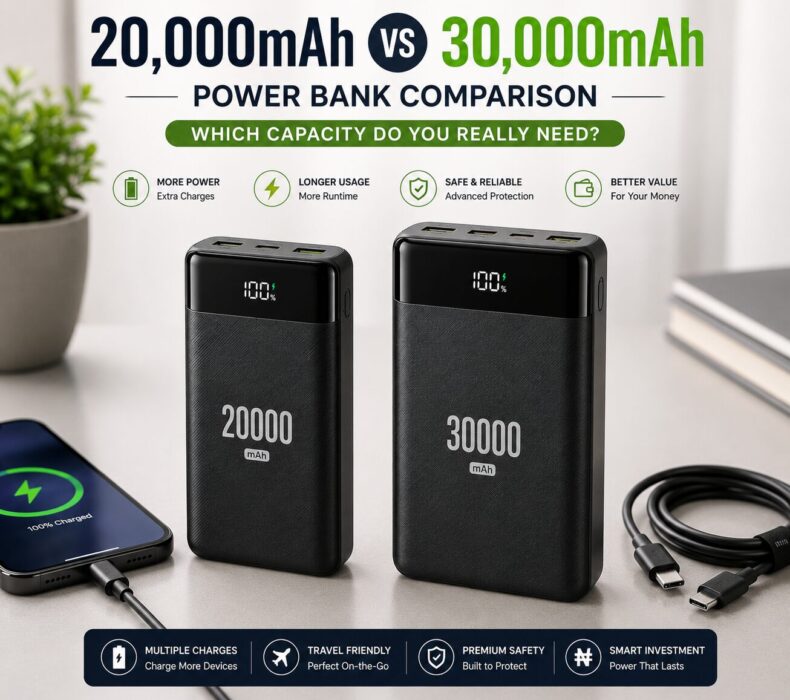
One of the most frequently debated and genuinely important questions among Nigerian power bank shoppers today is addressed directly and thoroughly in this comprehensive guide, because 20,000mAh vs 30,000mAh Power Banks: Which Capacity Do You Really Need? is the capacity decision that confuses more Nigerian buyers than almost any other portable charging specification in 2026. Furthermore, choosing the wrong capacity leads to one of two equally frustrating outcomes — either running out of power at the worst possible moment or carrying unnecessarily heavy equipment throughout your daily Nigerian routine. Therefore, this carefully structured and honestly presented guide examines every important factor that should influence your capacity decision, helping every Nigerian consumer choose the power bank size that perfectly matches their genuine daily needs.
Why Power Bank Capacity Choice Matters Deeply
First and foremost, battery capacity measured in milliampere-hours determines the total amount of electrical energy a power bank stores and delivers to connected devices. Consequently, choosing the right capacity is the single most foundational power bank purchasing decision any Nigerian consumer can make, because every other feature — charging speed, port count, build quality — becomes secondary if the total stored energy runs out before your devices are adequately charged.
Moreover, in Nigeria’s specific context where power supply remains unpredictable across many states and cities, the stakes of capacity choice are amplified significantly. In fact, a power bank that runs empty during an extended power outage, a long interstate journey, or a full day of remote work leaves you in exactly the same frustrated position as having no power bank at all. Therefore, understanding precisely how much capacity your specific lifestyle genuinely requires is absolutely essential before spending any Naira on a portable charger in 2026.
Understanding Real-World Capacity Delivery
Before comparing specific capacity options, it is critically important to understand that no power bank delivers one hundred percent of its advertised mAh capacity to connected devices. Specifically, energy is always lost through the conversion process that transforms the power bank’s internal voltage to the output voltage required by connected devices. Additionally, heat generation during charging further reduces effective energy transfer efficiency.
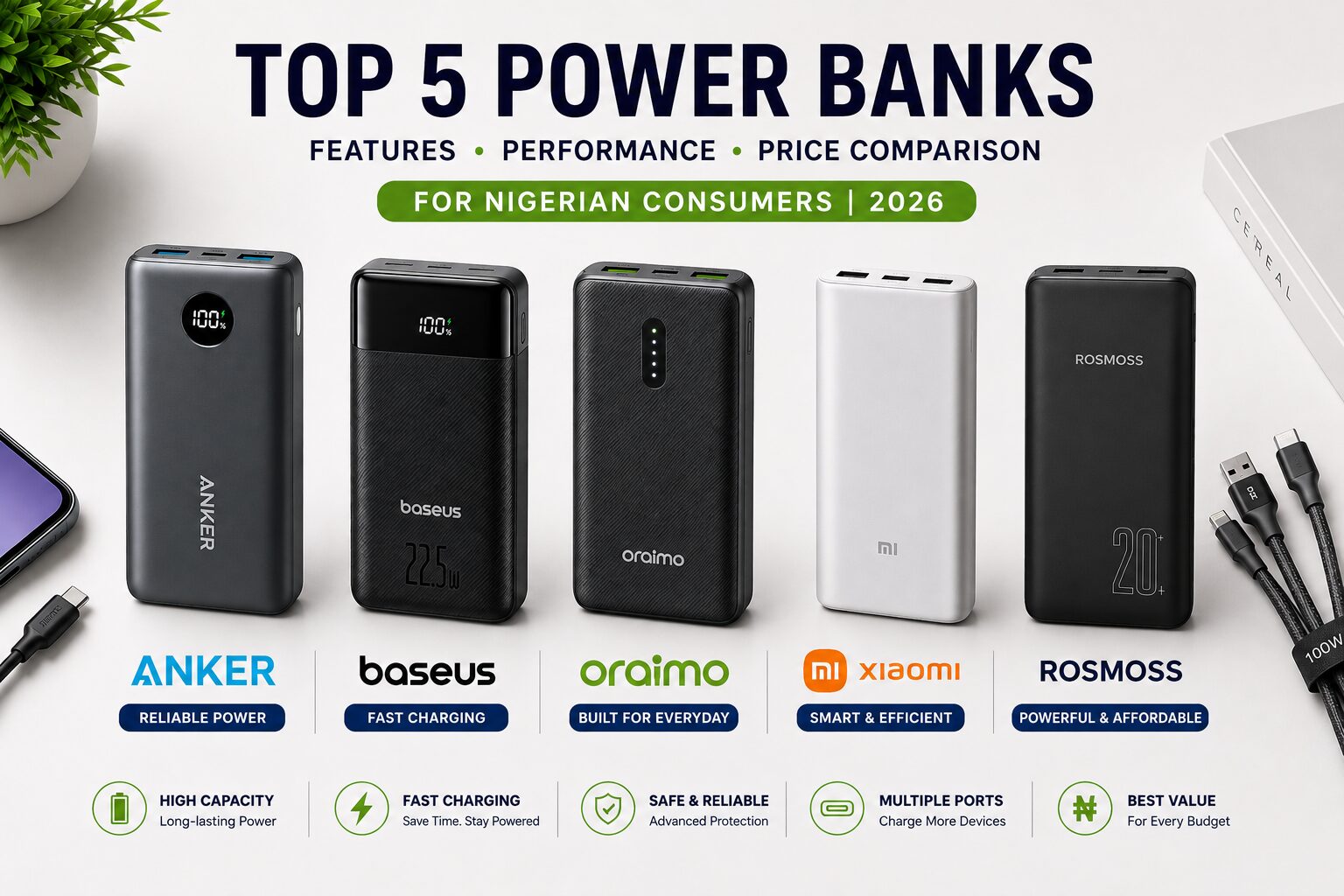
Furthermore, most quality power banks from reputable brands like Anker, Baseus, Xiaomi, Romoss, and Oraimo deliver between sixty-five and eighty percent of their advertised capacity as actual usable charge to connected devices. Consequently, a 20,000mAh power bank realistically delivers approximately 13,000mAh to 16,000mAh of usable charge, while a 30,000mAh model delivers approximately 19,500mAh to 24,000mAh of practical charging energy. Therefore, always apply this efficiency factor when calculating how many device charges your power bank will actually provide in real-world Nigerian usage conditions.
How Many Charges Does Each Capacity Provide?
Now that real-world delivery efficiency is clearly understood, calculating practical charge counts for common Nigerian devices becomes straightforward and genuinely useful.
20,000mAh Real-World Charging Estimates
Specifically, a quality 20,000mAh power bank operating at approximately seventy-five percent efficiency delivers around 15,000mAh of usable charge. Consequently, this translates to the following practical charging estimates for devices most commonly used by Nigerian consumers:
Standard Nigerian Smartphone (4,000mAh battery): Approximately 3 to 4 full charges
Large Smartphone (5,000mAh battery): Approximately 2 to 3 full charges
Mid-Range Tablet (7,000mAh battery): Approximately 1 to 2 full charges
Wireless Earbuds Case (500mAh): Approximately 20 to 25 full charges
Smartwatch (300mAh): Approximately 30 or more full charges
30,000mAh Real-World Charging Estimates
Moreover, a quality 30,000mAh power bank operating at approximately seventy-five percent efficiency delivers approximately 22,500mAh of usable charge. Consequently, the practical charging estimates for the same devices increase substantially:
Standard Nigerian Smartphone (4,000mAh battery): Approximately 5 to 6 full charges
Large Smartphone (5,000mAh battery): Approximately 4 to 5 full charges
Mid-Range Tablet (7,000mAh battery): Approximately 2 to 3 full charges
Wireless Earbuds Case (500mAh): Approximately 30 to 35 full charges
Smartwatch (300mAh): Approximately 45 or more full charges
Who Should Choose a 20,000mAh Power Bank?
Furthermore, understanding which Nigerian consumer profiles are best served by 20,000mAh capacity helps clarify whether this option meets your specific daily requirements.
Ideal for Everyday Urban Nigerian Users
Above all, the 20,000mAh power bank is the ideal capacity choice for Nigerian consumers who primarily use their power bank for daily urban commuting, office work, and standard smartphone and tablet charging throughout a typical workday. In other words, if you reliably return home or to an electricity source every evening and primarily need to maintain smartphone and wireless device charge across a single busy day, 20,000mAh provides more than adequate capacity for your genuine daily needs.
Perfect for Students and Young Professionals
Moreover, Nigerian students and young professionals who carry power banks in their bags to campus, co-working spaces, and client meetings will find 20,000mAh capacity perfectly sufficient for their typical daily charging requirements. Additionally, the more compact physical dimensions and lighter weight of most 20,000mAh models compared to 30,000mAh alternatives make them significantly more comfortable for daily bag carrying without adding unnecessary physical burden.
Suitable for Moderate Power Outage Scenarios
Furthermore, for Nigerian households experiencing moderate power outages of four to eight hours, a quality 20,000mAh power bank provides sufficient reserve capacity to maintain smartphone charge and keep wireless devices operational throughout typical outage durations without running critically low.
Who Should Choose a 30,000mAh Power Bank?
On the other hand, several specific Nigerian consumer profiles genuinely benefit from the additional capacity that 30,000mAh models provide, despite their increased size and weight.
Essential for Frequent Long-Distance Travelers
Specifically, Nigerian consumers who regularly travel long distances by road between cities like Lagos, Abuja, Port Harcourt, Kano, and Enugu will find 30,000mAh capacity genuinely essential rather than merely convenient. In fact, journeys exceeding eight hours with limited access to reliable charging points along the route can easily exhaust a 20,000mAh power bank when multiple devices require charging simultaneously throughout the trip. Consequently, the additional capacity buffer provided by a 30,000mAh unit eliminates charging anxiety entirely on extended Nigerian road journeys.
Ideal for Remote Workers and Field Professionals
Moreover, Nigerian remote workers, field engineers, outdoor market traders, and professionals who work in environments with unreliable or nonexistent electricity access throughout the workday will find 30,000mAh capacity provides a genuinely meaningful and practically important charging reserve. Additionally, the ability to charge laptops, smartphones, and tablets simultaneously across an entire extended workday without recharging the power bank itself makes 30,000mAh models particularly valuable for productivity-dependent Nigerian professionals.
Best for Severe Power Outage Areas
Furthermore, Nigerian households in areas experiencing extended power outages of twelve or more consecutive hours will find 30,000mAh capacity significantly more reassuring and practically useful than 20,000mAh alternatives. Consequently, the larger capacity reserve ensures that multiple household members can maintain smartphone charge across an entire day and night of power outage without exhausting the power bank before electricity is restored.
Key Trade-Offs Between Both Capacities
Additionally, beyond raw charging capacity, several important practical trade-offs differentiate 20,000mAh and 30,000mAh power banks that Nigerian consumers must carefully consider.
Physical Size and Weight:
Typically, 30,000mAh power banks are noticeably larger and heavier than 20,000mAh equivalents. Consequently, daily carry comfort is meaningfully reduced with 30,000mAh models, particularly for Nigerian consumers who walk significant distances during their daily commute.
Recharge Time:
Moreover, 30,000mAh power banks require significantly longer recharge times than 20,000mAh models. Therefore, consumers in areas with limited electricity windows should factor recharge time into their capacity decision carefully.
Airline Regulations:
Furthermore, most 30,000mAh power banks exceed international airline cabin luggage battery regulations. Consequently, frequent international Nigerian travelers must choose capacity carefully to avoid confiscation at airport security checkpoints.
Price Difference:
Additionally, 30,000mAh models typically cost between twenty and forty percent more than equivalent 20,000mAh alternatives from the same brand in the Nigerian market. Therefore, budget considerations should factor meaningfully into the final capacity decision.
Pricing Comparison in Nigerian Naira 2026
Below is a clear and practical pricing comparison between 20,000mAh and 30,000mAh models from brands most popular among Nigerian consumers:
Brand
20,000mAh Price (₦)
30,000mAh Price (₦)
Anker
₦44,000 – ₦60,000
₦56,000 – ₦76,000
Baseus
₦32,000 – ₦48,000
₦44,000 – ₦60,000
Xiaomi
₦28,000 – ₦40,000
₦36,000 – ₦52,000
Romoss
₦16,000 – ₦24,000
₦20,000 – ₦30,000
Oraimo
₦16,000 – ₦24,000
₦22,000 – ₦32,000
Final Recommendation
In conclusion, the right capacity choice between 20,000mAh and 30,000mAh depends entirely on your specific Nigerian lifestyle, daily device usage patterns, travel frequency, and budget. Specifically, choose 20,000mAh if you are an everyday urban commuter, student, or moderate power outage user who values portability and lighter daily carry weight. Conversely, choose 30,000mAh if you are a frequent long-distance traveler, remote worker, or severe power outage household resident who needs maximum charging reserve above all other considerations. By honestly matching your capacity choice to your genuine daily Nigerian needs, you will make the most satisfying and practically effective power bank investment possible in 2026.







 Get it on
  Download on the