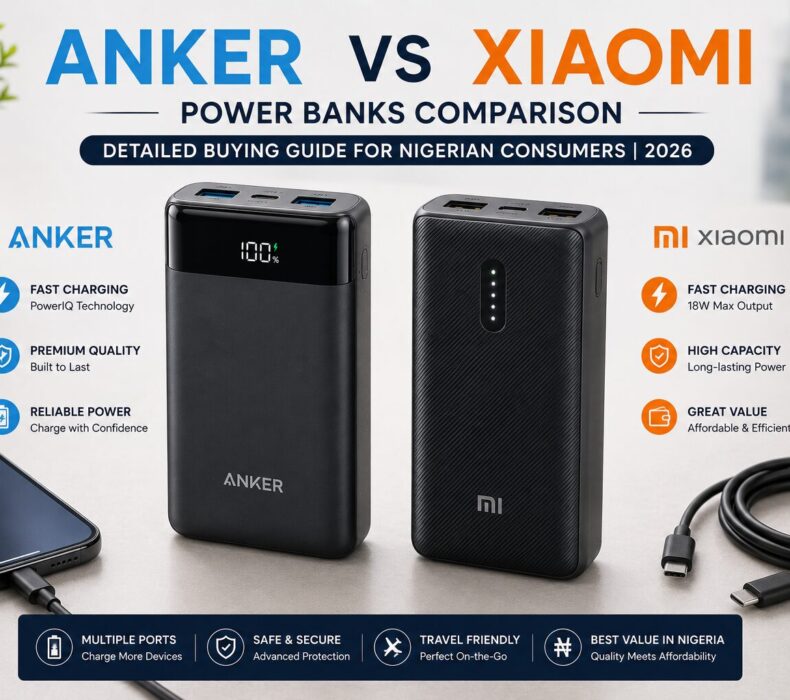
Two of the most frequently discussed portable charger brands among Nigerian tech consumers today are brought together in this comprehensive buying guide, because Anker vs Xiaomi Power Banks: Which Should You Buy in 2026? It is one of the most searched power bank questions across Nigeria right now. Furthermore, both brands have earned strong reputations for quality, performance, and value within the Nigerian market, making this comparison particularly challenging for consumers trying to decide between them. However, despite their surface-level similarities, significant differences exist in charging technology, build quality, pricing, and long-term reliability that will ultimately determine which brand is the right fit for your specific Nigerian lifestyle and budget. Therefore, this detailed and honestly presented comparison covers every important aspect you need to consider before spending your hard-earned Naira on either brand in 2026.
Brand Background and Market Reputation
First and foremost, understanding what each brand stands for helps establish the right context for this comparison. In fact, Anker was founded specifically as a premium charging accessories company and has spent over a decade building a global reputation for advanced battery technology, rigorous quality control, and industry-leading customer support. Consequently, Anker is widely regarded as the gold standard of portable charging reliability across multiple international markets including Nigeria.
On the other hand, Xiaomi is primarily known as a comprehensive consumer electronics brand whose power bank lineup represents just one component of a much broader product ecosystem. Moreover, Xiaomi has built an exceptionally strong reputation for delivering impressive technical specifications at very competitive price points, making their power banks particularly attractive to value-conscious Nigerian consumers. Therefore, while Anker leads in premium quality perception, Xiaomi excels in delivering outstanding specifications per Naira spent.
Battery Capacity and Real-World Performance
When comparing actual battery performance, both Anker and Xiaomi demonstrate above-average capacity accuracy compared to the broader Nigerian power bank market. However, some notable differences emerge upon closer examination.
Specifically, Anker’s PowerCore series consistently delivers real-world capacity retention that remains above eighty-five percent of advertised rating even after five hundred charge cycles, which is a genuinely impressive long-term performance benchmark. Furthermore, Anker’s premium lithium polymer cells maintain this performance level consistently across Nigeria’s varied temperature conditions throughout the year.
Meanwhile, Xiaomi’s Power Bank 3 Pro series also delivers respectable real-world capacity accuracy, typically maintaining above eighty percent of advertised rating across similar cycle counts. Moreover, Xiaomi’s verified capacity testing and transparent specification reporting make their products significantly more trustworthy than many competing mid-range alternatives available in the Nigerian market. Consequently, while Anker maintains a slight edge in long-term capacity retention, Xiaomi’s performance at its price point is genuinely outstanding.
Charging Speed and Technology Comparison
Furthermore, charging speed and technology represent one of the most significant and practically impactful differences between these two brands for Nigerian consumers.
Anker’s premium lineup integrates the most advanced charging technologies available in 2026, including Power Delivery 3.1, Gallium Nitride charging optimization, and proprietary PowerIQ 4.0 technology. Consequently, top Anker models achieve outputs of 45W to 140W, making them the most capable laptop and multi-device fast charging power banks available to Nigerian consumers at any price point.
In contrast, Xiaomi’s best power banks in 2026 typically offer between 33W and 67W USB-C Power Delivery output, which delivers genuinely fast charging for smartphones and tablets but may fall slightly short for the most demanding laptop fast charging scenarios. However, for the vast majority of Nigerian consumers who primarily charge smartphones and tablets rather than laptops, Xiaomi’s charging speeds are more than adequate. Therefore, the practical charging speed gap between these brands narrows considerably for typical Nigerian everyday use cases.
Build Quality and Durability
Additionally, build quality is another area where meaningful differences between Anker and Xiaomi emerge for Nigerian consumers. Specifically, Anker consistently uses premium Grade A battery cells, aerospace-grade aluminum or high-density ABS plastic casings, and reinforced charging port construction across their entire power bank lineup. As a result, Anker products typically demonstrate superior physical durability and longer service lives under intensive Nigerian everyday use conditions.
Moreover, Anker’s comprehensive MultiProtect safety system provides twelve distinct protection layers that consistently safeguard connected devices against overcharging, temperature spikes, voltage surges, and short circuits. Consequently, Anker offers the most comprehensively protected charging experience available in the Nigerian market.
Meanwhile, Xiaomi’s power banks feature solid build quality with aluminum alloy or premium plastic construction and reliable safety protection systems. Furthermore, Xiaomi’s build standards are consistently impressive for their price range, significantly exceeding what competing mid-range brands typically offer. Nevertheless, Anker’s overall construction quality remains demonstrably superior upon direct physical comparison.
Price and Overall Value Comparison
Perhaps the most decisive factor in this Anker vs Xiaomi comparison for Nigerian consumers is the significant pricing difference between the two brands. Below is a clear pricing comparison across equivalent capacity models:
Xiaomi Power Bank 3 Ultra 20000mAh 67W:
₦32,000 – ₦48,000
Therefore, Xiaomi consistently offers comparable capacity and often superior wattage output at approximately thirty to forty percent lower Naira pricing than equivalent Anker models. Consequently, the value-per-Naira calculation clearly favors Xiaomi for budget-conscious Nigerian consumers. However, the premium you pay for Anker buys measurably superior long-term durability and a more comprehensive safety protection system.
Side-By-Side Comparison Table 2026
Feature
Anker
Xiaomi
Battery Cell Quality
Premium Grade A
Very Good
Max Charging Output
Up to 140W
Up to 67W
Capacity Accuracy
85%+ after 500 cycles
80%+ after 500 cycles
Charge Cycle Rating
1,000+ cycles
800+ cycles
Build Quality
Premium
Very Good
Safety Protection
12-Layer MultiProtect
Multi-Layer
Price Range (₦)
₦44,000 – ₦64,000
₦28,000 – ₦48,000
Local Warranty Support
Limited
Limited
Value Per Naira
Good
Excellent
Overall Rating
⭐⭐⭐⭐⭐
⭐⭐⭐⭐½
Which Brand Suits Which Nigerian Consumer?
Now that you have a thorough understanding of both brands across every important category, matching the right choice to your specific situation becomes straightforward.
First and foremost, choose Anker if you are a Nigerian professional who charges laptops, premium tablets, and multiple high-end devices simultaneously on a daily basis. Furthermore, choose Anker if maximum long-term durability and the most comprehensive safety protection system available are your absolute top priorities, and you are comfortable investing a premium Naira amount for the finest portable charging reliability available.
On the other hand, choose Xiaomi if you primarily charge smartphones and tablets rather than laptops and need genuinely impressive fast charging performance at a significantly more accessible Naira price point. Moreover, choose Xiaomi if you want verified capacity accuracy and solid build quality without paying the full Anker premium. Consequently, Xiaomi delivers outstanding value for the majority of typical Nigerian everyday charging needs.
Additionally, consider Xiaomi if you are a student, young professional, or budget-conscious consumer who needs reliable performance without overspending. Conversely, consider Anker if you are a heavy tech user whose devices represent significant professional investments that absolutely require the safest possible charging environment.
Where to Buy in Nigeria
Both Anker and Xiaomi power banks are available through Nigeria’s most trusted technology retailers. Specifically, Jumia Nigeria, Konga, and Slot consistently stock genuine verified versions of both brands with accessible warranty coverage. Furthermore, always purchase exclusively from verified sellers providing original sealed packaging and genuine warranty documentation to fully protect your investment.
Moreover, watch for Jumia Flash Sales and seasonal promotional campaigns throughout 2026, as these regularly deliver significant Naira savings across both Anker and Xiaomi power bank models.
Final Verdict
In conclusion, both Anker and Xiaomi are outstanding power bank brands that serve different segments of the Nigerian consumer market exceptionally well in 2026. Specifically, Anker is the right choice if premium long-term reliability, maximum charging speed, and the most comprehensive safety protection available are your non-negotiable requirements. Meanwhile, Xiaomi is the smarter choice if outstanding performance per Naira, impressive fast charging capability, and verified capacity accuracy within a more accessible budget represent your primary purchasing priorities.
Ultimately, you cannot make a genuinely wrong decision by choosing either brand. However, by honestly assessing your daily charging needs, your budget, and your long-term performance expectations, this comparison has given you everything needed to make the most confident, well-informed, and satisfying power bank purchase decision in Nigeria in 2026.









 Get it on
  Download on the