Buying a laptop in Nigeria can be stressful, especially with so many options available. In addition, prices vary significantly depending on the brand, specifications, and seller. As a result, many people end up buying laptops that do not meet their actual needs.
Fortunately, understanding a few important factors before making a purchase can save you money, frustration, and future repair costs. Whether you are a student, freelancer, gamer, business owner, or content creator, choosing the right laptop is extremely important.
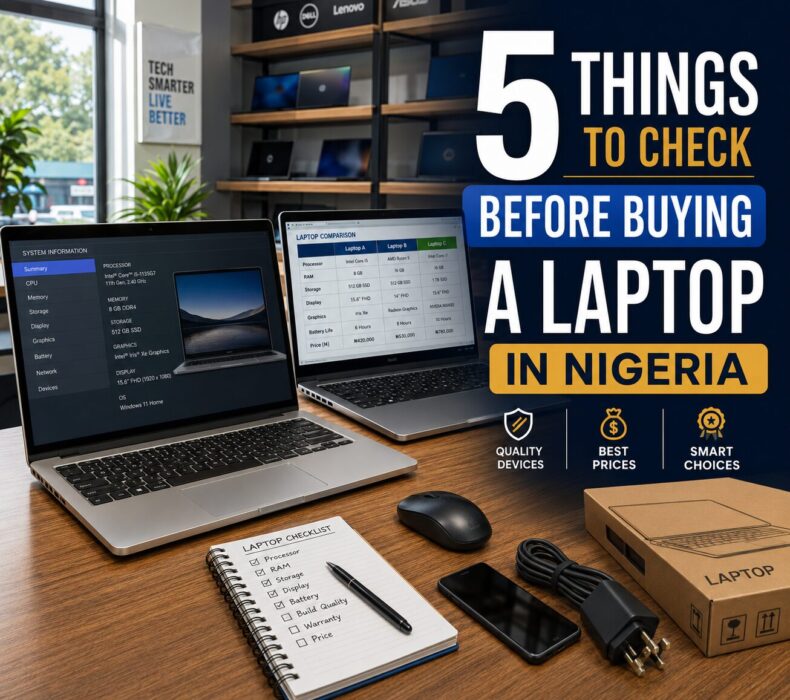
Therefore, before spending your hard-earned money, here are five essential things you should check before buying a laptop in Nigeria.
1. Check the Laptop Processor
First and foremost, the processor is the brain of the laptop. Consequently, it greatly affects speed and overall performance.
For basic tasks such as browsing, typing, and watching videos, Intel Core i3 or AMD Ryzen 3 processors may be sufficient. However, if you plan to multitask, edit videos, design graphics, or play games, you should consider Intel Core i5, Core i7, or AMD Ryzen 5 and Ryzen 7 processors.
Moreover, newer generations usually perform better and consume less power.
Therefore, always ask for:
The processor type
Generation number
Performance capability
As a result, you will avoid buying outdated systems that quickly become slow.
2. Check the RAM Size
Equally important, RAM determines how smoothly your laptop handles multiple applications.
For example:
4GB RAM is suitable only for light usage.
8GB RAM is ideal for most users.
16GB RAM or higher is recommended for creators and gamers.
In many Nigerian markets, some sellers promote laptops with powerful processors but very low RAM. Consequently, performance may still feel slow. Therefore, always confirm the RAM size before purchasing.
In addition, ask whether the RAM can be upgraded later.
3. Check the Storage Type
Many buyers focus only on storage capacity. However, the storage type matters even more.
Today, SSD storage is significantly faster than traditional HDD storage.
As a result:
Laptops boot faster
Applications open quickly
Overall performance improves dramatically
For example:
256GB SSD often performs better than 1TB HDD.
Therefore, if possible, choose SSD storage or a laptop that supports SSD upgrades.
4. Check Battery Health and Original Charger
This is especially important in Nigeria because many laptops sold in local markets are refurbished or fairly used.
Consequently, some laptops may have weak batteries or fake chargers.
Before buying:
Test the battery life
Confirm charging speed
Check whether the charger is original
Inspect the charging port carefully
Furthermore, poor batteries can reduce productivity and lead to additional expenses later. Therefore, never ignore battery condition.
5. Check the Laptop’s Physical Condition
Finally, carefully inspect the laptop physically before payment.
For example, check:
Keyboard condition
Screen quality
Hinges
USB ports
Webcam
Speakers
Wi-Fi connectivity
In addition, look for cracks, overheating signs, or unusual noises. Moreover, if you are buying a fairly used laptop, ask whether any parts have been replaced. As a result, you reduce the risk of future hardware issues.
Bonus Tip: Buy From Trusted Sellers
Although cheaper deals may seem attractive, buying from unreliable sellers can be risky.
Therefore, purchase from:
Authorized stores
Trusted online marketplaces
Reputable computer dealers
In addition, always request a warranty whenever possible.
Common Mistakes Buyers Make
Many buyers in Nigeria:
Prioritize brand over specifications
Ignore battery condition
Buy outdated processors
Choose HDD instead of SSD
Purchase laptops without warranty
Consequently, they experience poor performance shortly after buying. Therefore, understanding these mistakes can help you make a smarter decision.
Final Thoughts
In conclusion, buying a laptop in Nigeria requires careful attention to specifications, battery condition, storage type, and overall build quality.
Whether you are purchasing a brand-new or fairly used device, checking these five important factors will help you avoid costly mistakes and choose a laptop that truly fits your needs.
Ultimately, the best laptop is not necessarily the most expensive one. Instead, it is the one that delivers reliable performance, long-term value, and the right features for your work or lifestyle.













 Get it on
  Download on the