Running a professional laundry service in Nigeria requires more than just washing and ironing clothes. One of the biggest challenges dry cleaners face is keeping track of customers’ garments, especially when handling bulk orders. Misplaced items, mix-ups, and delays can damage a business’s reputation. That’s where a professional laundry labeling system for dry cleaners comes in. Cleaneat explores how a laundry management system with tagging ensures efficiency, accuracy, and customer trust.
Professional Laundry Labeling System for Dry Cleaners: The Basics
What is Laundry Tagging?
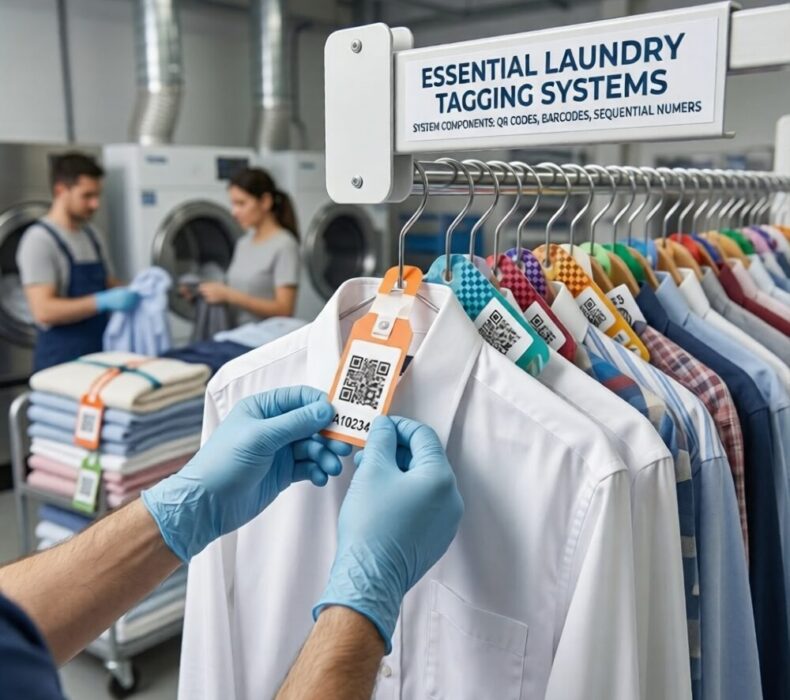
Laundry tagging is the process of attaching a unique identifier to each garment received by a laundry service. This identifier helps track the garment throughout the cleaning cycle—from drop-off to washing, ironing, packaging, and delivery.
Why Tagging Matters
Prevents mix-ups between customers’ clothes.
Ensures accurate billing and record-keeping.
Improves workflow efficiency.
Enhances customer satisfaction and trust.
Types of Laundry Tagging Systems
Paper Tags
Traditional method using printed tags.
Attached with pins or staples.
Affordable but prone to tearing or fading.
Barcode Tags
Each garment is assigned a barcode.
Scanned at different stages for tracking.
Reduces human error and speeds up processing.
RFID Tags
Uses radio-frequency identification technology.
Allows bulk scanning without direct contact.
Ideal for large-scale laundries handling thousands of garments.
Heat-Sealed Labels
Permanent labels attached to uniforms or institutional laundry.
Common in hospitals, hotels, and schools.
Laundry Management System with Tagging
Digital Integration
Modern laundries use software systems that integrate with tagging methods. These systems:
Track garments in real-time.
Generate invoices automatically.
Send SMS or email notifications to customers.
Provide data analytics for business growth.
Benefits of Digital Tagging
Accuracy: Minimizes human error.
Efficiency: Speeds up sorting and packaging.
Transparency: Customers can track their orders.
Scalability: Suitable for small shops and large industrial laundries.
Professional Laundry Labeling System for Dry Cleaners: Practical Applications
For Small-Scale Laundries
Paper or barcode tags are cost-effective.
Simple software integration for billing and tracking.
For Medium-Scale Laundries
Barcode systems with digital management.
SMS notifications for customers.
For Large-Scale Laundries
RFID tagging for bulk garment handling.
Advanced laundry management systems with analytics.
Comparison Table: Tagging Systems
Tagging Method
Cost
Accuracy
Suitability
Paper Tags
Low
Moderate
Small laundries
Barcode Tags
Moderate
High
Medium laundries
RFID Tags
High
Very High
Large laundries
Heat-Sealed Labels
Moderate
High
Institutional laundry
How to Implement a Laundry Management System with Tagging
Step 1: Assess Business Needs
Determine the volume of garments handled daily.
Identify customer expectations.
Step 2: Choose the Right Tagging Method
Paper tags for startups.
Barcode or RFID for growing businesses.
Step 3: Invest in Software
Select laundry management software compatible with your tagging system.
Ensure it offers invoicing, notifications, and analytics.
Step 4: Train Staff
Educate employees on tagging procedures.
Emphasize accuracy and customer communication.
Step 5: Monitor and Improve
Regularly review system performance.
Upgrade technology as the business grows.
Risks and Challenges
Tag Loss: Paper tags may tear or fall off.
Counterfeit Tags: Poor-quality tags can cause confusion.
Cost of Technology: RFID systems are expensive for small businesses.
Staff Training: Improper tagging can lead to errors.
In the debate of professional laundry labeling system for dry cleaners, tagging is not optional—it’s essential. Whether using paper, barcode, or RFID, a laundry management system with tagging ensures efficiency, accuracy, and customer satisfaction. Nigerian laundries that adopt modern tagging systems will stand out in a competitive market, building trust and profitability.














 Get it on
  Download on the